Medically reviewed by: Dr. Nagesh H A, MBBS, MS (Orthopedics), Consultant Orthopedician and Joint Specialist Last reviewed: 21 October 2026
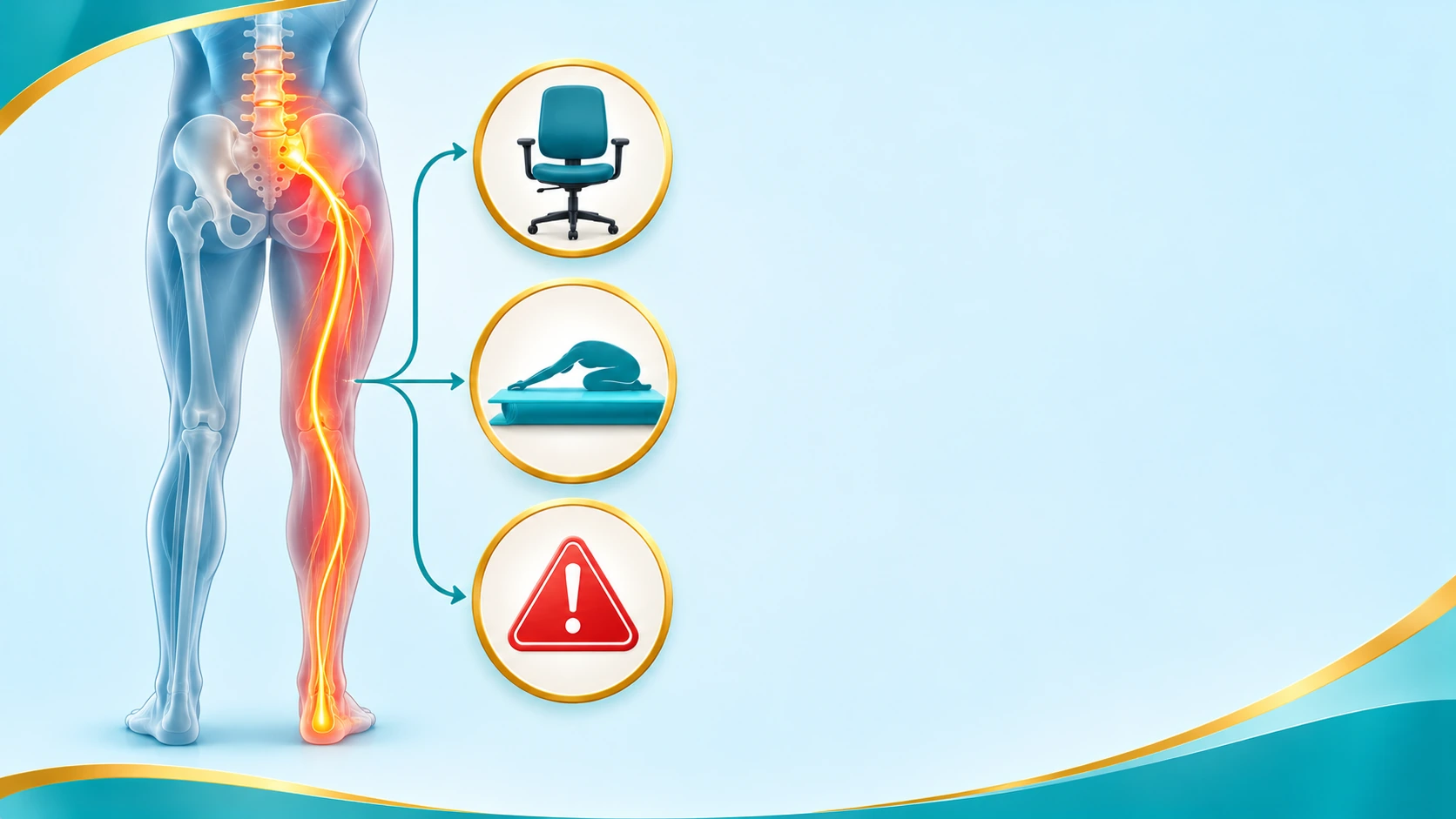
Sciatica is not a diagnosis in itself. It is a name for pain that travels from the lower back or buttock down the leg along the path of the sciatic nerve, the thickest nerve in the body. It can feel like an electric shock, burning, tingling or deep ache, and it often worsens with sitting, coughing or bending. In most people it improves within weeks with simple care. In a small number, it signals a problem that needs prompt medical attention. This guide helps you tell the difference.
Key points: Most sciatica improves within 4 to 6 weeks, and up to 12 weeks, with staying active, simple pain relief and physiotherapy. Staying in bed is not advised. Go to the emergency department if you have numbness around the groin or buttocks, new difficulty controlling urine or stool, or fast-worsening leg weakness.
The sciatic nerve is formed from nerve roots in the lower spine. It runs through the buttock and down the back of each leg. When one of these roots or the nerve itself is irritated or compressed, pain is felt along its path, usually on one side only.
- Pain from the lower back or buttock that shoots down the back of the thigh to the calf or foot
- Burning, tingling or pins and needles in the leg or foot
- Numbness in part of the leg or foot
- Pain that gets worse with sitting, coughing, sneezing or bending forward
- Weakness in the leg, ankle or toes, such as dragging the foot
- A constant ache in one buttock
| Cause |
How it causes sciatica |
| Lumbar disc herniation (“slip disc”) |
The soft center of a disc pushes out and presses on a nerve root. This is the most common cause |
| Lumbar spinal stenosis |
Narrowing of the spinal canal squeezes the nerves, more common after 50 |
| Spondylolisthesis |
A vertebra slips forward over the one below |
| Piriformis syndrome |
A tight muscle in the buttock irritates the sciatic nerve |
| Pregnancy |
Weight and posture changes, hormone-related loosening of ligaments |
| Injury, infection, tumor (rare) |
Direct damage or pressure on the nerve |
Risk factors include age (30 to 60), prolonged sitting, heavy lifting with a bent back, a physically demanding job, smoking, overweight, diabetes and weak core muscles.
A slipped (herniated) disc is a common cause, but sciatica is the symptom. Your doctor works out what is irritating the nerve. Not every slipped disc causes sciatica, and not every sciatica comes from a disc.
| Pain pattern |
Possible cause |
| Pain below the knee into the foot, with tingling |
Nerve root irritation (sciatica) |
| Back pain without leg symptoms |
Muscle or joint strain |
| Pain in both thighs when walking that eases on sitting |
Spinal stenosis |
| Flank pain with burning urine or blood in urine |
Kidney stone or infection |
| Hip pain in the groin |
Hip joint problem |
Emergency warning signs (cauda equina syndrome): numbness in the groin, genitals or inner thighs (the “saddle” area); new difficulty passing urine or controlling bladder or bowels; weakness in both legs; leg weakness that is getting worse fast. Go to an emergency department immediately. Also seek urgent care for sciatica after a major injury, with fever or unexplained weight loss, or with a history of cancer.
The doctor takes a history, checks strength, reflexes and sensation, and performs a straight-leg-raise test. Imaging is not needed for everyone. An MRI of the lower spine is advised when there are warning signs, when pain has not improved after about 6 weeks of treatment or when injections or surgery are being considered. An X-ray can show bony changes, and a nerve conduction study is used in selected cases.
- Keep moving. Gentle walking and normal daily activity help recovery more than bed rest.
- Heat or cold packs for 15 to 20 minutes can ease pain.
- Pain relief: short courses of anti-inflammatory medicines or paracetamol, and sometimes muscle relaxants or nerve-pain medicines, as prescribed by your doctor. Please do not self-medicate for long, especially if you have kidney, stomach or heart problems.
- Posture: avoid slumping. Use a small lumbar roll behind the lower back when sitting, and change position every 30 minutes.
A physiotherapist designs a programme with gentle stretches and core and hip strengthening. Treatment may include manual therapy and advice on posture and lifting.
If severe pain continues after several weeks of conservative care, an epidural steroid injection near the irritated nerve root may give short-term relief and help you take part in physiotherapy. It does not fix the underlying cause.
Surgery, such as microdiscectomy, is considered for:
- Severe leg pain that has not improved after around 6 to 12 weeks of proper treatment
- Progressive leg weakness or foot drop
- Cauda equina syndrome (urgent)
Your surgeon will discuss the benefits and risks. Most people with sciatica do not need surgery.
These are general examples. If a movement sends pain further down the leg, stop and ask a professional.
- Knee-to-chest stretch: lie on your back and gently bring one knee toward the chest. Hold 15 to 20 seconds. Repeat 3 times on each side.
- Piriformis stretch: lie on your back, cross the sore leg’s ankle over the other knee and gently pull the lower thigh toward you. Hold 20 seconds.
- Cat-camel: on hands and knees, slowly arch and round the back, 8 to 10 times.
- Bird-dog: on hands and knees, extend the opposite arm and leg while keeping the back level. Hold 5 seconds, 6 to 8 times each side.
- Short walks: 10 to 15 minutes, several times a day, on level ground.
Avoid forceful forward bending, heavy lifting, long driving without breaks and high-impact exercise until the pain eases.
Long hours at a desk, hours in traffic and two-wheeler commutes strain the lower back. Small habits help: stand and walk for 2 to 3 minutes every 30 minutes, set the chair so that the knees are slightly below the hips, keep a wallet out of the back pocket while sitting, use a back support on long rides and lift by bending the knees and keeping the load close.
- Keep active, with regular walking, swimming or cycling
- Strengthen your core and hips
- Maintain a healthy weight
- Do not smoke
- Lift correctly and avoid twisting while lifting
- Use a firm, supportive mattress that suits you
- Pain that has lasted for more than 2 weeks, or recurs often
- Leg weakness or numbness
- Pain that wakes you at night
- Pain after a fall or accident
- Back pain with fever, weight loss or a history of cancer
The Orthopedics department at Genesiss Hospital, BTM Layout, examines back and leg pain, advises on imaging when needed and discusses medicine, physiotherapy and procedural options. We are at 17, 100 Feet Ring Road, near Jayadeva Metro, BHBCS Layout, BTM 2nd Stage, Bengaluru 560076. Emergency care is available round the clock. See spine and back problems or our guide on which doctor to consult for back pain.
What is the main cause of sciatica?
The most common cause is a herniated lumbar disc pressing on a nerve root. Other causes include spinal stenosis, spondylolisthesis, a tight piriformis muscle and, rarely, infection or a tumor.
How long does sciatica last?
Most people improve within 4 to 6 weeks, and many within 12 weeks, with active care. Some have recurring episodes, and a few have long-lasting symptoms that need further treatment.
Is walking good for sciatica?
Yes, gentle walking on level ground is usually helpful. Avoid long bouts of sitting and avoid positions that send pain further down the leg.
Should I rest in bed with sciatica?
Short rests are fine, but prolonged bed rest tends to slow recovery. Staying gently active is advised.
When is sciatica an emergency?
With numbness around the groin or buttocks, new loss of bladder or bowel control, or rapidly worsening weakness in the legs. Go to an emergency department immediately.
Do I need an MRI for sciatica?
Not always. An MRI is advised when there are warning signs, when pain has not improved after about 6 weeks or when injections or surgery are being considered.
Is sciatica the same as a slipped disc?
No. Sciatica is the symptom of nerve irritation, and a slipped disc is one of the common causes.
17, 100 Feet Ring Road, near Jayadeva Metro, BHBCS Layout, BTM 2nd Stage, BTM Layout, Bengaluru, Karnataka 560076.
Phone: +91 98867 77592 | Email: contact@genesisshospital.com
Emergency and trauma care are available round the clock.
Book an appointment | Contact us | Our doctors
This article is for general health information. It is not a substitute for examination, diagnosis or treatment by a qualified doctor. If you think you may have an emergency, go to the nearest emergency department or call the hospital.