Medically reviewed by: Dr. Nagesh H A, MBBS, MS (Orthopedics), Consultant Orthopedician and Joint Specialist Last reviewed: 27 October 2026
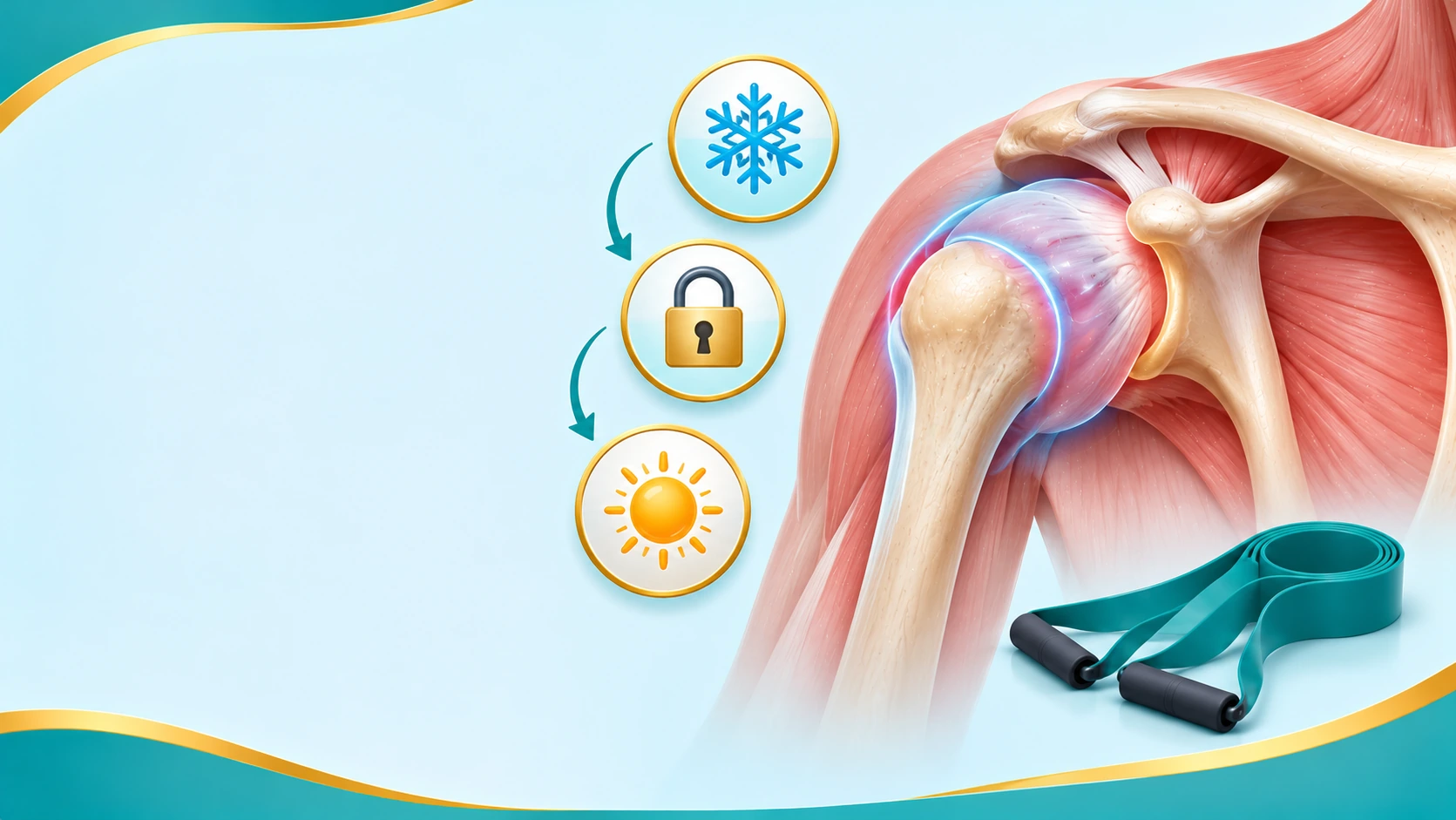
You reach for a seat belt, a shelf or your back pocket, and a sharp pain stops you. Over weeks, the shoulder stiffens until combing hair or fastening a blouse becomes difficult. Sleeping on that side is painful. This pattern is typical of a frozen shoulder, also called adhesive capsulitis. It is frustrating because it lasts longer than most injuries, but in most people the shoulder gradually improves. Knowing which stage you are in tells you what to do and what to avoid.
Key points: Frozen shoulder goes through three stages over about 1 to 3 years. Treatment is matched to the stage: pain control early, gentle stretching as the shoulder stiffens and strengthening as it thaws. It is more common in people with diabetes and thyroid disease. Injections, hydrodilatation and surgery are options for selected people. A shoulder that is weak, rather than stiff, may be a rotator cuff problem.
The shoulder joint is surrounded by a thin, flexible capsule. In frozen shoulder, this capsule becomes inflamed and thickened, and then tight, which limits movement in all directions, both when you move it yourself and when someone else moves it for you. That last point helps doctors tell frozen shoulder from a torn tendon.
- Usually adults between 40 and 60 years, and more often women
- People with diabetes (as many as 1 in 5 may be affected at some point), and those with thyroid disease
- After a period of immobility, such as after a fracture, surgery, a stroke or a heart procedure
- People with a previous frozen shoulder in the other shoulder
- Some people with Parkinson’s disease or other long-term health conditions
Often there is no clear reason.
- Dull or aching pain deep in the shoulder, often worse at night
- Trouble lying on the affected side
- Gradual loss of movement, especially reaching up, behind the back or rotating the arm outwards
- Difficulty with everyday tasks: dressing, bathing, combing hair, reaching a high shelf, fastening a bra or shirt, wearing a seat belt
- Stiffness that persists even when the pain starts to ease
| Stage |
Typical duration |
What you feel |
Focus of care |
| 1. Freezing (painful) |
About 2 to 9 months |
Increasing pain, worse at night, movement slowly lessens |
Control pain and inflammation. Keep gentle movement within comfort |
| 2. Frozen (stiff) |
About 4 to 12 months |
Pain eases but stiffness is greatest |
Stretching with a physiotherapist, sometimes a procedure |
| 3. Thawing (recovery) |
About 5 to 24 months |
Movement returns gradually |
Stretching and strengthening to restore function |
The overall course often runs 1 to 3 years, and most people regain good movement, although some are left with mild stiffness.
The doctor examines the shoulder, checking how far it moves actively (on its own) and passively (when the doctor moves it). In frozen shoulder, both are limited, particularly turning the arm outwards. An X-ray rules out arthritis, a fracture or calcium deposits. An ultrasound or MRI is only used if a rotator cuff tear or another problem is suspected. Blood sugar and thyroid tests may be advised.
Short courses of anti-inflammatory tablets, heat packs and modification of activities help in the early painful stage. A gentle sleeping position, such as lying on the other side with a pillow supporting the sore arm, can ease night pain.
Regular, gentle stretching guided by a physiotherapist is the foundation of treatment. The aim is to stretch to the point of mild tension and not into sharp pain. Pushing too hard in the painful stage can aggravate the shoulder.
A corticosteroid injection into the shoulder joint can reduce pain and allow exercise, particularly in the painful early stage. Benefits are usually short term, and in people with diabetes, it can temporarily raise blood sugar. Your doctor will explain the benefits and risks.
In this procedure, fluid (saline with a steroid and local anesthetic) is injected to gently stretch the capsule. It is considered for selected people with persistent stiffness.
If stiffness remains severe after many months of physiotherapy and other treatments, a doctor may suggest manipulation of the shoulder under anesthesia or an arthroscopic (keyhole) capsular release to cut the tight capsule. Physiotherapy straight afterwards is essential to keep the movement gained.
Do these after a warm shower or heat pack, once or twice a day. Stop if you have sharp or lasting pain. These are general examples, and your physiotherapist will personalize them.
- Pendulum swing: lean forward, resting your good hand on a table. Let the sore arm hang loose and sway it in small circles, 20 to 30 seconds, 2 to 3 times.
- Table slide: sit at a table with your hand on a towel. Slide the arm forward by bending from the hips, until you feel a mild stretch. Hold 10 to 15 seconds, repeat 5 to 8 times.
- Wall walk: face a wall and walk your fingers up as far as comfortable. Hold for a few seconds and walk down. Repeat 5 to 10 times.
- Cross-body stretch: use the good hand to gently bring the sore arm across the chest. Hold 15 to 20 seconds, repeat 3 to 5 times.
- Towel stretch behind the back: hold a towel behind your back with both hands and gently pull upward with the good arm to lift the sore hand. Hold a few seconds, repeat 5 times.
- Outward rotation with a stick: lying on your back with elbows by your sides, hold a stick or umbrella and use the good arm to push the sore hand outwards. Hold 5 to 10 seconds, repeat 8 to 10 times.
Aim for regularity over intensity. Mild stretching tension is expected, and pain that lingers for more than an hour afterwards means you did too much.
People with diabetes have a higher chance of frozen shoulder, tend to have more severe and longer stiffness, and may develop it in both shoulders. Good blood sugar control helps overall health and may help recovery. If you are advised a steroid injection, tell your doctor about your diabetes so the sugar level can be monitored afterwards.
|
Frozen shoulder |
Rotator cuff tear |
Shoulder arthritis |
| Movement |
Stiff when moved by you and by the doctor |
Weak to lift the arm, but can often be moved passively |
Stiff and grating, X-ray shows joint changes |
| Pain |
Night pain, ache at rest |
Pain on lifting, weakness |
Pain with activity, morning stiffness |
| Age |
40 to 60 |
Any age, often after injury or above 50 |
Often above 50 |
Neck problems can also refer pain to the shoulder, so an examination matters.
- Shoulder pain that continues for more than 2 to 3 weeks or is waking you at night
- Stiffness that is getting worse or limiting daily tasks
- You have diabetes or thyroid disease and a new shoulder problem
- Pain after a fall or injury, or shoulder weakness
- Fever, a swollen red joint, or pain with chest pain or breathlessness, which need urgent care
The Orthopedics department at Genesiss Hospital, BTM Layout, assesses shoulder pain and stiffness, advises on imaging when needed and discusses the treatment options suited to each stage. We are at 17, 100 Feet Ring Road, near Jayadeva Metro, BHBCS Layout, BTM 2nd Stage, Bengaluru 560076. Many patients come from Jayanagar, JP Nagar, Koramangala and HSR Layout. Read about our Orthopedics department or about sports injuries and soft tissue disorders.
How long does frozen shoulder last?
Usually 1 to 3 years in total, moving through the painful, stiff and thawing stages. Most people regain good movement, but some have mild lasting stiffness.
How can I speed up recovery from a frozen shoulder?
There is no instant fix. Pain control, regular gentle stretching and, for selected people, a steroid injection or hydrodilatation can speed up comfort and movement. Forcing the shoulder too hard can worsen it.
Can a frozen shoulder go away on its own?
Yes, in most people it improves over time. Treatment and exercise aim to reduce pain, keep movement and may shorten the stiff period.
Which exercises help a frozen shoulder?
Gentle pendulum swings, table slides, wall walks, cross-body stretches and outward rotation with a stick, matched to your stage and done within comfort. A physiotherapist can tailor them.
Does diabetes cause frozen shoulder?
Diabetes does not directly cause it, but people with diabetes get frozen shoulder more often and may have a longer, more stubborn course. Good blood sugar control is advised.
Is surgery needed for frozen shoulder?
Rarely. It is considered when severe stiffness persists after many months of other treatment. Options include manipulation under anesthesia and arthroscopic capsular release.
Is a steroid injection safe for frozen shoulder?
It is commonly used and generally well tolerated, with short-term benefits. Risks include temporary pain flare and a temporary rise in blood sugar in people with diabetes. Your doctor will discuss whether it suits you.
17, 100 Feet Ring Road, near Jayadeva Metro, BHBCS Layout, BTM 2nd Stage, BTM Layout, Bengaluru, Karnataka 560076.
Phone: +91 98867 77592 | Email: contact@genesisshospital.com
Emergency and trauma care are available round the clock.
Book an appointment | Contact us | Our doctors
This article is for general health information. It is not a substitute for examination, diagnosis or treatment by a qualified doctor. If you think you may have an emergency, go to the nearest emergency department or call the hospital.