Medically reviewed by: Dr. Nagesh H A, MBBS, MS (Orthopedics), Consultant Orthopedician and Joint Specialist Last reviewed: 23 October 2026
A twist on the football field, a sudden squat on the floor or even getting up from a low seat can leave you with a swollen, catching knee. A meniscus tear is one of the most common knee injuries. It can happen to athletes in their twenties and to people in their fifties with no clear injury at all. Some tears settle with rehabilitation, and some need keyhole surgery. This guide explains the types, symptoms, tests, treatment choices and recovery.
Key points: The meniscus is a pair of C-shaped cartilage cushions in the knee. Tears from injury (common in younger people) and tears from wear (common after 40) are managed differently. Many degenerative tears improve with physiotherapy. A knee that is locked and cannot fully straighten, or that keeps giving way, should be assessed promptly. Surgery either repairs the tear or trims the torn part.
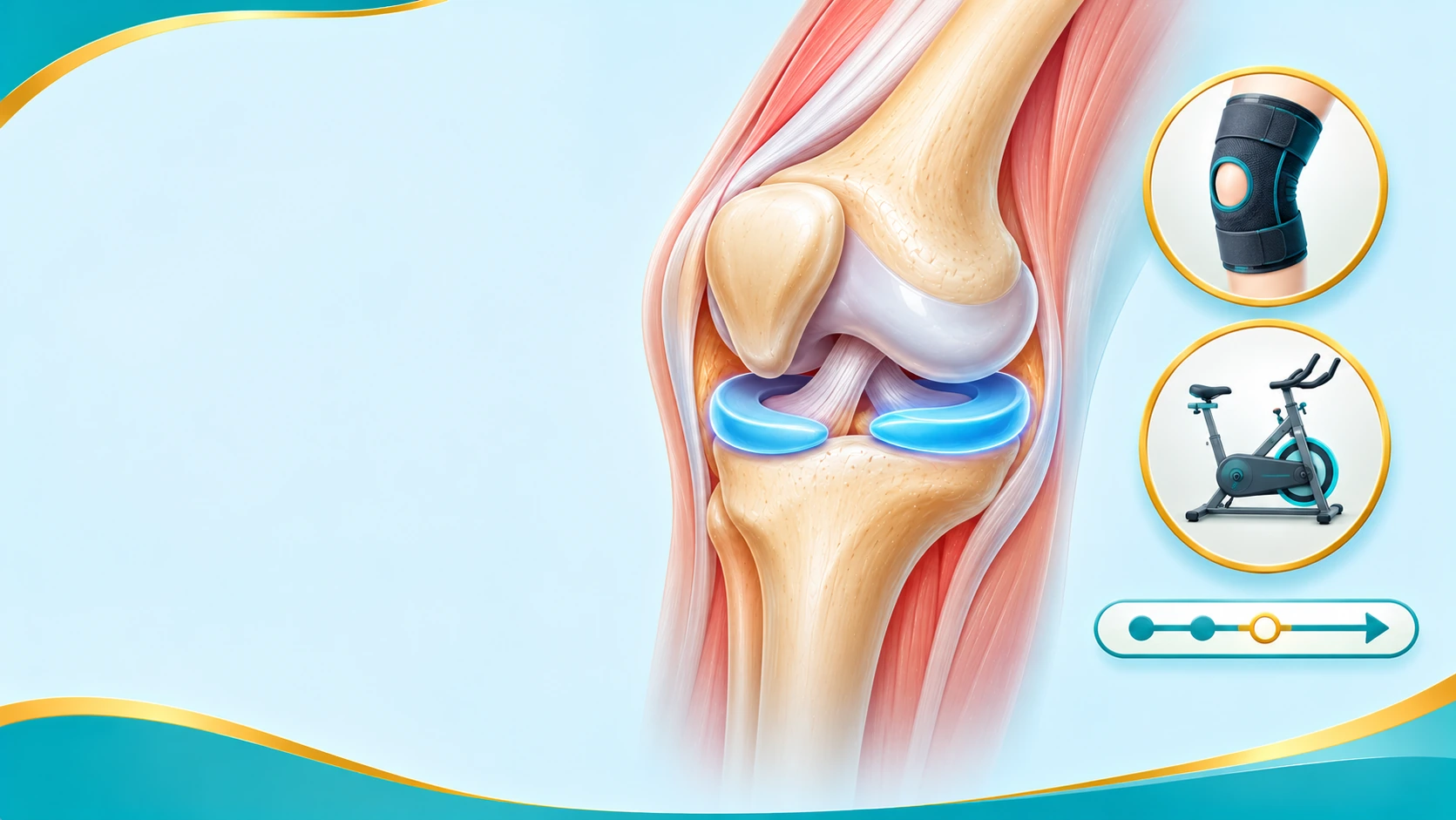
Each knee has two menisci, one on the inner side (medial) and one on the outer side (lateral). They sit between the thigh bone and the shin bone, act as shock absorbers, spread weight across the joint and help keep the knee stable. Their outer edge has a blood supply and can heal, while the inner part has little or none.
- Traumatic tears: a twisting injury with the foot planted, as in football, cricket, badminton, kabaddi or a fall. Often associated with ligament injuries such as an ACL tear.
- Degenerative tears: gradual wear after the age of 40 or 50, which can happen with minimal strain. Deep squatting, sitting cross-legged on the floor and repeated stair climbing are common triggers in Indian households.
- Occupational stress: jobs requiring kneeling, squatting or heavy lifting.
- Pain along the inner or outer side of the knee, often at the joint line
- Swelling that develops over a day or two after the injury
- Stiffness and difficulty fully straightening or bending the knee
- Catching, clicking or a feeling that something is stuck in the joint
- The knee giving way or feeling unstable
- Pain on twisting, squatting or climbing stairs
- A knee that locks and will not fully straighten
Get urgent orthopedic care if the knee is locked and will not straighten, if it is very swollen and cannot bear weight after an injury, or if there is a feeling of the knee giving way, because other injuries may be present.
The doctor examines the knee for tenderness along the joint line, swelling and range of motion, and performs special tests such as the McMurray and Thessaly tests. An X-ray does not show the meniscus, but rules out fractures and arthritis. An MRI shows the meniscus clearly and any other injuries such as ligament tears. MRI findings must be interpreted with the symptoms, because many people over 40 have meniscus changes on MRI without having pain.
| Type |
Common in |
Notes |
| Longitudinal or bucket-handle |
Younger, active people |
Can flip and lock the knee. Often repairable |
| Radial |
Any age |
May be hard to heal because of the location |
| Horizontal or degenerative |
Over 40 |
Often due to wear, may respond to rehabilitation |
| Complex |
Mixed |
Several patterns together |
The treatment depends on the type of tear, your age, activity level, whether the knee is locked and other injuries.
- Rest and activity change: avoid twisting, deep squatting and impact sports for a while
- Ice: 15 to 20 minutes a few times a day when the knee is swollen
- Compression and elevation to control swelling
- Pain relief: short courses of anti-inflammatory medicines as advised by your doctor
- Support: a knee sleeve or brace may help comfort
A structured programme to restore movement and strengthen the thigh and hip muscles. For many degenerative tears without locking, studies show that physiotherapy gives results similar to surgery in the first years. A programme of 8 to 12 weeks is usually tried first.
Surgery is considered when the knee is locked, when there are persistent mechanical symptoms (catching or giving way) after rehabilitation, or for a repairable tear in a younger person. Surgery is usually done by arthroscopy (keyhole) through small cuts.
| Operation |
What happens |
Recovery |
| Meniscus repair |
The torn edge is stitched back so it can heal |
Protected weight-bearing and brace for about 4 to 6 weeks. Return to sport at about 4 to 6 months |
| Partial meniscectomy |
The torn, unstable piece is trimmed away |
Walking within days, many return to desk work in 1 to 2 weeks. Sport at about 4 to 8 weeks |
Preserving the meniscus when possible is preferred, because removing a large part increases the chance of arthritis later. Your surgeon will explain which option is suitable for your type of tear.
These are examples for the early phase, once swelling has settled, and not for a locked knee. A physiotherapist can tailor them to your tear.
- Quadriceps sets: lie with the leg straight, tighten the thigh muscle, press the knee down and hold 5 seconds. Repeat 10 times.
- Straight leg raise: with the knee straight, lift the leg about 30 cm. Hold 3 seconds. Repeat 10 times.
- Heel slides: lying down, slowly bend the knee by sliding the heel toward you, then straighten. Repeat 10 times.
- Hamstring curls (standing): hold a support and bend the knee, bringing the heel toward the buttock. Repeat 10 times.
- Stationary cycling and short walks as the knee tolerates.
Avoid deep squats, pivoting, twisting and kneeling until your doctor or physiotherapist says it is safe.
| Situation |
Typical recovery |
| Mild tear managed without surgery |
Several weeks to 3 months of rehabilitation |
| Partial meniscectomy |
Daily activities in a few weeks. Sports at about 1 to 2 months |
| Meniscus repair |
About 4 to 6 months before return to sport. Protected movement in the first weeks |
Recovery depends on the type of tear, the person’s age, rehabilitation and any additional injuries.
Small tears at the outer edge, where there is a blood supply, can heal. Tears in the inner part often do not heal but may stop causing symptoms. A tear that causes locking, catching or repeated giving way is less likely to settle without treatment. Do not assume that an untreated tear is harmless, and do not assume that every tear needs surgery. The decision is individual.
- Warm up before exercise and strengthen the thighs, hips and calves
- Avoid sudden twisting on a planted foot
- Wear footwear that suits the sport and the surface
- Take care with deep squatting on the floor and consider a stool or a toilet seat if you have knee pain
- Maintain a healthy weight
The Orthopedics department at Genesiss Hospital, BTM Layout, assesses knee injuries, advises on MRI when needed and discusses rehabilitation and surgical options based on the type of tear and your needs. We are at 17, 100 Feet Ring Road, near Jayadeva Metro, BHBCS Layout, BTM 2nd Stage, Bengaluru 560076. Emergency and trauma care are available round the clock. Read about sports injuries and soft tissue disorders and our guide on knee pain in women.
What are the symptoms of a meniscus tear?
Pain at the joint line, swelling, stiffness, catching or clicking, the knee giving way and difficulty straightening it. A knee that locks needs prompt assessment.
Does a meniscus tear need surgery?
Not always. Many degenerative tears improve with physiotherapy. Surgery is considered for a locked knee, persistent catching or giving way after rehabilitation, or a repairable tear in a younger person.
How long does it take to recover from a meniscus tear?
From a few weeks to 3 months for tears treated with rehabilitation. After partial trimming, many return to sport in 1 to 2 months. After repair, return to sport takes about 4 to 6 months.
Can I walk with a meniscus tear?
Many people can walk, sometimes with pain. If the knee is locked, very swollen or giving way, avoid weight-bearing and see an orthopedic doctor.
Can a meniscus tear heal without surgery?
Small tears near the outer edge, which has a blood supply, can heal. Tears in the inner part usually do not heal but may settle and stop causing symptoms.
Is an MRI necessary for a meniscus tear?
An MRI shows the meniscus and other knee injuries most clearly. Your doctor will decide if it is needed based on your symptoms and examination.
What exercises are safe after a meniscus tear?
Gentle thigh-strengthening, heel slides, straight leg raises and stationary cycling are common early choices. Avoid deep squats, twisting and impact until your doctor or physiotherapist advises.
17, 100 Feet Ring Road, near Jayadeva Metro, BHBCS Layout, BTM 2nd Stage, BTM Layout, Bengaluru, Karnataka 560076.
Phone: +91 98867 77592 | Email: contact@genesisshospital.com
Emergency and trauma care are available round the clock.
Book an appointment | Contact us | Our doctors
This article is for general health information. It is not a substitute for examination, diagnosis or treatment by a qualified doctor. If you think you may have an emergency, go to the nearest emergency department or call the hospital.