Medically reviewed by: Dr. Divya J G, MBBS, MS (OBG), DNB, FMAS, FRM, Consultant Obstetrician and Gynaecologist Last reviewed: 26 October 2026
Anti-Mullerian hormone, or AMH, is one of the most requested blood tests in fertility clinics, and one of the most misunderstood. A report arrives with a number, such as 0.8 or 4.2, and a range printed next to it, and you are left wondering whether that number says anything about your chances of becoming a mother. This guide explains what AMH measures, how to read the result by age, what low and high values may mean and, just as important, what AMH cannot tell you.
Key points: AMH reflects the number of small follicles (egg reserve) in the ovaries. It does not measure egg quality, and it does not predict by itself whether you will conceive naturally. It can be tested on any day of the cycle. It is read together with age, an ultrasound antral follicle count and your history. A low value is a reason to talk to a doctor, not a reason to panic.
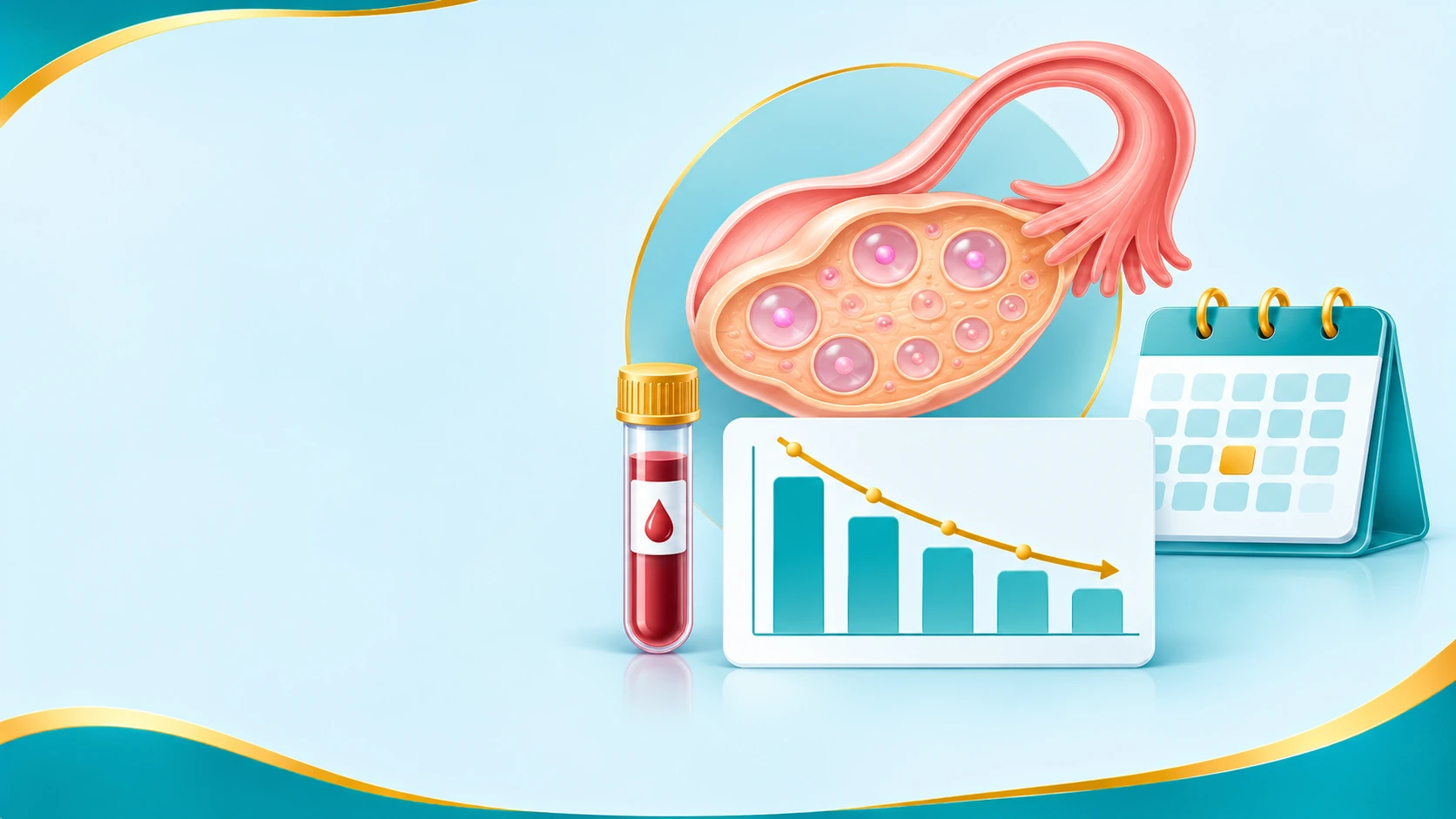
AMH is a hormone made by small, early-stage follicles in the ovaries. The more of these follicles you have, the higher the AMH, so the blood level gives an estimate of your ovarian reserve, the pool of eggs still available. A woman is born with all her eggs, and their number falls with age, so AMH generally declines as a woman gets older.
- To assess ovarian reserve when a woman is trying to conceive or planning to delay pregnancy
- To help plan fertility treatment, such as the stimulation dose in IVF, and to predict whether the ovaries are likely to respond weakly or strongly
- As part of evaluation for polycystic ovary syndrome (PCOS), where levels are often higher
- To help evaluate early or premature ovarian insufficiency
- Before treatments that can affect the ovaries, so that options can be discussed
AMH levels stay relatively steady during the menstrual cycle, so the test can be taken on any day, without fasting. Hormonal contraception can lower AMH slightly in some women, and recent ovarian surgery or chemotherapy can also affect the value, so tell your doctor about these.
Reference ranges differ between laboratories and test methods, so always use the range printed on your report. The following is a commonly used guide, in ng/mL and its equivalent in pmol/L (1 ng/mL is about 7.14 pmol/L).
| AMH (ng/mL) |
AMH (pmol/L) |
General interpretation |
| Below 0.5 |
Below 3.6 |
Very low reserve |
| 0.5 to 1.0 |
3.6 to 7.1 |
Low reserve |
| 1.0 to 3.5 |
7.1 to 25 |
Usual or satisfactory range |
| Above 3.5 |
Above 25 |
High, may be seen in PCOS |
AMH is naturally higher in the twenties and falls gradually with age.
| Age |
Typical AMH (ng/mL), approximate |
| About 25 |
Around 3.0 |
| About 30 |
Around 2.5 |
| About 35 |
Around 1.5 to 2.0 |
| About 40 |
Around 0.5 to 1.0 |
| About 45 |
Below 0.5 |
These are averages. Healthy women fall above and below them, and a single value should never be judged without age and clinical context.
A low AMH suggests a smaller pool of remaining eggs than is typical for your age. This does not mean you cannot conceive. Many women with low AMH conceive naturally, and many with normal AMH take longer. A low value may mean:
- Less time to act if you are planning a pregnancy, so earlier evaluation is useful
- A lower response to ovarian stimulation, so your doctor may plan treatment differently
- A reason to look at other markers, such as the antral follicle count on ultrasound and FSH
If your AMH is low, it helps to speak with a fertility specialist about your goals and timeline. See our page on diminished ovarian reserve treatment for how care is planned.
A high AMH is commonly seen in women with PCOS, because they have many small follicles. It is not harmful in itself. In fertility treatment, a high AMH suggests a stronger response to ovarian stimulation, and your doctor will adjust medicines to lower the risk of overstimulation. If you have irregular periods or other symptoms, a PCOS assessment may be advised. See our page on PCOS treatment.
- Egg quality: AMH reflects number, not quality. Quality is mainly linked to age.
- Whether you will conceive naturally: it does not predict pregnancy on its own.
- The exact age of menopause: AMH gives only a rough indication.
- Tubal or uterine health, ovulation or your partner’s sperm: these need other tests.
This is why doctors read AMH along with an ultrasound for antral follicle count, a hormone profile and the couple’s complete history. For a full picture of tests, see infertility evaluation.
AMH reflects follicle numbers. There is no proven way to raise it permanently. Healthy habits, such as not smoking, maintaining a healthy weight, treating thyroid and vitamin deficiencies and managing stress, support general reproductive health. Supplements are heavily advertised for this purpose, but evidence is limited, and you should take them only on your doctor’s advice.
If you are planning to delay pregnancy, an AMH test and an antral follicle count help a specialist estimate how ovaries might respond to stimulation for egg freezing. They do not predict how many freezing cycles you will need. Read about egg freezing cost in Bangalore for what to consider.
The price depends on the laboratory and method (some tests use automated analyzers, others use ELISA), whether it is combined with other tests such as FSH, LH, estradiol and thyroid tests, and whether a consultation or ultrasound is included. Prices vary between labs and over time. To check the current charge for an AMH test at Genesiss Hospital, call +91 98867 77592.
- Women over 30 planning a pregnancy, especially if there is a delay
- Women with irregular cycles or suspected PCOS
- Couples trying to conceive for 6 to 12 months without success
- Women planning IVF, IUI or egg freezing
- Women with a history of ovarian surgery, endometriosis, chemotherapy or radiation
- Women with a family history of early menopause
The Fertility team at Genesiss Hospital, BTM Layout, explains each test and its meaning in a private consultation, and puts the result in context with your age, cycles and goals. We are at 17, 100 Feet Ring Road, near Jayadeva Metro, BHBCS Layout, BTM 2nd Stage, Bengaluru 560076, and women visit from Jayanagar, JP Nagar, Koramangala, HSR Layout and Bannerghatta Road. See our Male and Female Infertility and IVF department page.
What is a normal AMH level for my age?
It varies by lab and age. A common guide is about 1.0 to 3.5 ng/mL as a usual range, with higher values in the twenties and lower values after 35. Use the range printed on your report and discuss it with your doctor.
Can I take the AMH test on any day of my cycle?
Yes. AMH is stable through the cycle, so it can be taken on any day, without fasting.
Does low AMH mean I cannot get pregnant?
No. Low AMH means fewer remaining eggs than typical for your age, but many women with low AMH conceive. It does mean time may matter, so it is wise to speak with a doctor.
Does a high AMH mean PCOS?
Not always, but PCOS is a common reason. Diagnosis needs other findings such as irregular cycles, signs of high androgens or ultrasound features.
Can AMH predict menopause?
It gives only a rough indication. It is not accurate enough to predict the exact timing.
Does AMH show egg quality?
No. AMH reflects the number of eggs, not their quality. Quality is mainly related to age.
How much does an AMH test cost?
The price varies by laboratory and what is bundled with the test. Call the hospital for the current charge.
17, 100 Feet Ring Road, near Jayadeva Metro, BHBCS Layout, BTM 2nd Stage, BTM Layout, Bengaluru, Karnataka 560076.
Phone: +91 98867 77592 | Email: contact@genesisshospital.com
Emergency and trauma care are available round the clock.
Book an appointment | Contact us | Our doctors
This article is for general health information. It is not a substitute for examination, diagnosis or treatment by a qualified doctor. If you think you may have an emergency, go to the nearest emergency department or call the hospital.