Medically reviewed by: Dr. Vijay Reddy, MBBS, MS, Consultant General Surgeon Last reviewed: 25 October 2026
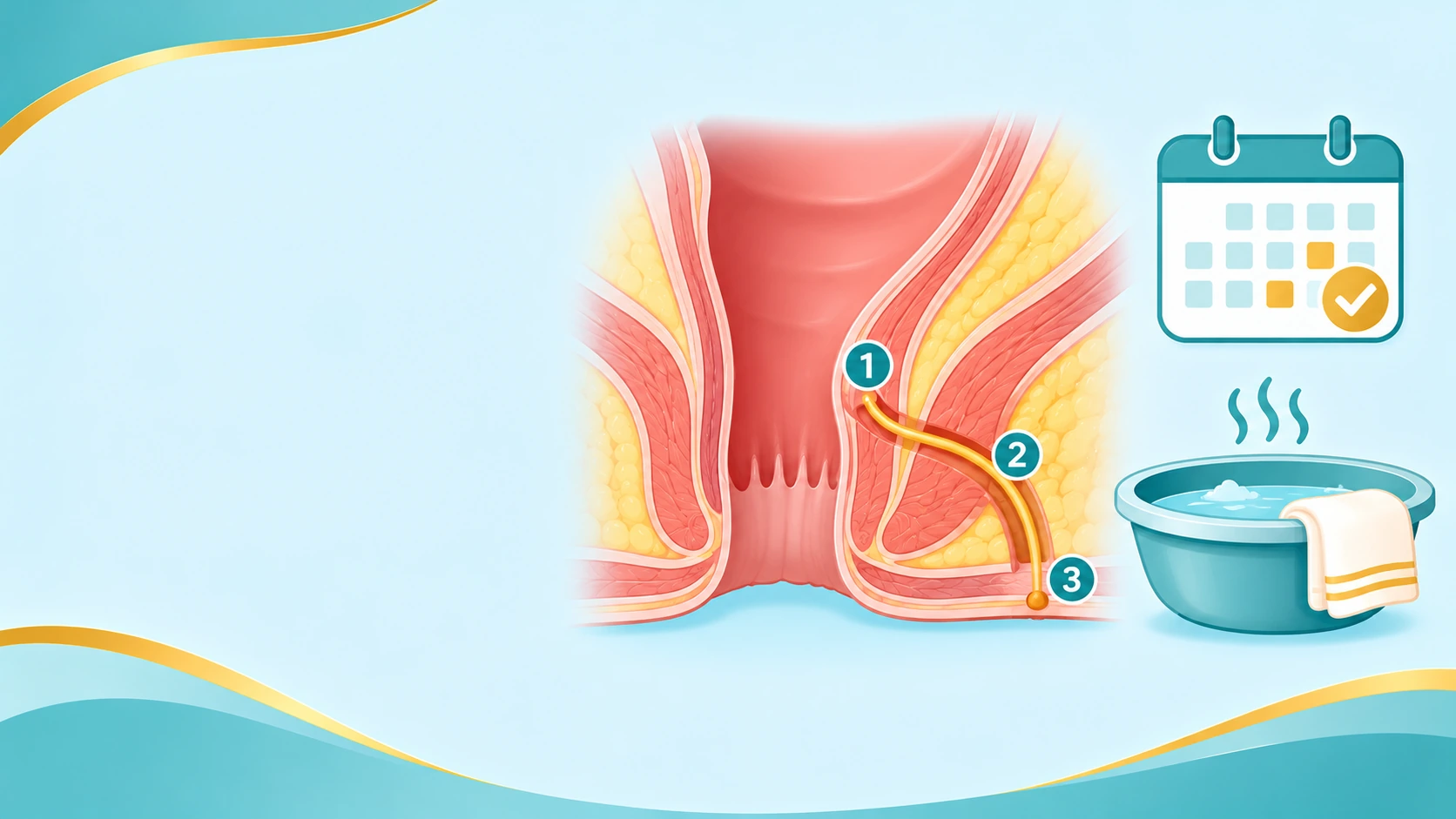
An anal fistula is a small tunnel that forms between the inside of the anal canal and the skin around the anus. People often notice it as a boil that bursts, a spot near the anus that keeps leaking pus or a painful lump that keeps coming back. Because the symptoms overlap with piles and fissures, many people try creams for months before seeing a surgeon. A fistula usually does not heal on its own, and the right surgery depends on exactly where the tunnel runs. This guide explains the types, the main surgery options, what recovery involves and the questions to ask before you decide.
Key points: Most anal fistulas start as an abscess near the anus that did not fully heal. Medicines and creams do not close a fistula. Surgery is usually needed, and the type depends on how much of the sphincter muscle the tunnel crosses. Good surgeons aim to clear the infection while protecting bowel control.
Small glands lie inside the anal canal. When one gets blocked and infected, it forms an abscess near the anus. Once the abscess drains, a tunnel can remain between the gland and the skin. That tunnel is the fistula. It keeps discharging because bowel bacteria keep entering it.
Less commonly, fistulas are linked to Crohn’s disease, tuberculosis, injury, earlier surgery, radiation or other conditions. In India, a doctor will often keep tuberculosis in mind for a stubborn or recurrent fistula and test for it when needed.
- Repeated pus, blood or foul-smelling fluid leaking near the anus
- A small opening on the skin (like a pimple) that does not heal
- Pain, swelling and redness around the anus, often worse when sitting or passing stool
- Recurring abscesses in the same area, sometimes with fever
- Skin irritation and itching from constant discharge
Seek care promptly if you have severe pain, swelling, redness and fever. This can be an abscess that needs draining.
|
Piles |
Fissure |
Fistula |
| What it is |
Swollen anal cushions |
A small tear in the anal lining |
A tunnel from the anal canal to the skin |
| Main symptom |
Bright red bleeding, lump |
Sharp pain with stool, a little blood |
Pus discharge, recurrent boils |
| Heals with creams and diet? |
Often, in early stages |
Often |
No. It needs surgery |
The surgeon examines the area and may use a thin probe or a short scope in the clinic or under anesthesia. Tests that help map the tunnel include an MRI of the pelvis, an endoanal ultrasound and sometimes a fistulogram. This mapping tells the surgeon whether the tunnel is low (small part of the muscle) or high (crossing a larger part), and whether there are side branches. Blood tests and a chest X-ray or other tests may be advised to look for underlying causes such as Crohn’s disease or tuberculosis.
The surgeon classifies fistulas by how they relate to the sphincter muscles, which control stool:
- Intersphincteric: between the two layers of the sphincter, the most common type
- Transsphincteric: crossing the sphincter muscles
- Suprasphincteric and extrasphincteric: higher and less common, and harder to treat
Fistulas are also called simple (single, low) or complex (high, with branches, recurrent, or linked to Crohn’s).
| Procedure |
How it works |
Suits |
Key points |
| Fistulotomy |
The tunnel is laid open and left to heal from the base |
Low, simple fistulas |
Most established. Heals in weeks. Not suitable if too much muscle would be cut |
| Seton placement |
A soft thread is passed through the tunnel to drain it or slowly guide healing |
High or complex fistulas, or as a first stage |
May stay for weeks or months. Protects the sphincter |
| LIFT (ligation of intersphincteric fistula tract) |
The tunnel is tied off and divided between the muscle layers |
Selected transsphincteric fistulas |
Spares the sphincter. Failure may need another procedure |
| Advancement flap |
A flap of healthy rectal lining covers the internal opening |
Complex fistulas |
Spares muscle. Needs precise surgery. Recurrence is possible |
| Laser or other minimally invasive closure, fibrin glue, plug |
The tunnel is shrunk or filled |
Selected cases |
Results vary, and repeat treatment may be needed |
No single procedure is right for every fistula. Success depends on the type of fistula, the surgeon’s experience and how well the wound is cared for. Ask your surgeon for realistic expectations for your type of fistula. Percentages quoted on advertisements often do not apply to individual cases.
Fistula surgery is usually done under spinal or general anesthesia and is often a day-care procedure or needs a short hospital stay. The surgeon may need to treat an abscess first and plan the main procedure for a later date.
| Stage |
What to expect |
| First 2 to 3 days |
Pain controlled with medicines, a dressing in place, light discharge |
| First 1 to 2 weeks |
Sitz baths two to three times a day, regular dressings, stool softeners. Many people return to desk work within 1 to 2 weeks |
| 4 to 8 weeks |
A wound that was laid open often heals in this period |
| Seton or staged procedures |
Healing takes longer and needs regular follow-up |
Keep stool soft with fiber and water. Avoid heavy lifting and long periods of sitting on hard surfaces during the early weeks. Report fever, rising pain, heavy bleeding, new swelling or leakage of stool or gas.
All surgeries have risks. For fistula surgery these include recurrence of the fistula, infection, delayed healing, bleeding, and in some cases some degree of leakage of gas or stool, depending on how much muscle is involved. Your surgeon will explain the risk for your specific type before surgery. This is why choosing the procedure that protects the sphincter, even if it needs two stages, is often reasonable.
The cost depends on the type of fistula, the procedure chosen, whether an MRI and other investigations are needed, anesthesia type, hospital stay and follow-up. Prices quoted online are rarely comparable. To get the current charges at Genesiss Hospital, call +91 98867 77592 and ask for an estimate after your consultation.
See a surgeon if you have a boil near the anus that bursts and keeps draining, recurring abscesses, pus discharge for more than two weeks or pain and swelling with fever. Do not wait for it to “dry up” because it often returns.
The General Surgery department at Genesiss Hospital, BTM Layout, evaluates anorectal conditions, explains the type of fistula and discusses the surgical options available for you. We are located at 17, 100 Feet Ring Road, near Jayadeva Metro, BHBCS Layout, BTM 2nd Stage, Bengaluru 560076. Patients also come from Jayanagar, JP Nagar, Koramangala and HSR Layout. Read our piles treatment guide if your symptoms are mainly bleeding, or visit the General Surgery department page.
Can an anal fistula heal without surgery?
Rarely. The tunnel keeps getting re-infected from the bowel, so it usually persists or returns. Medicines can control infection and pain, but surgery is generally needed to close it.
Which surgery is suitable for anal fistula?
It depends on the type of fistula. Fistulotomy suits low, simple fistulas. Seton, LIFT and flap procedures are used for higher or complex fistulas to protect bowel control. Your surgeon decides after examination and scans.
How long does it take to recover from fistula surgery?
Many people return to desk work in 1 to 2 weeks, and the wound often heals over 4 to 8 weeks. Complex fistulas treated in stages take longer.
Is fistula surgery painful?
Pain is expected for the first few days and is managed with medicines, stool softeners and sitz baths. Pain usually eases over the first week or two.
Can a fistula come back after surgery?
Yes, recurrence can happen, particularly with complex fistulas or underlying conditions such as Crohn's disease or tuberculosis. Following your surgeon's instructions and attending follow-up lowers the risk.
What is the difference between a fistula and an abscess?
An abscess is a collection of pus that causes painful swelling. A fistula is the tunnel that can remain after an abscess drains. An abscess needs urgent drainage.
Does fistula surgery affect bowel control?
Surgery that cuts through a lot of the sphincter can affect control. This risk is why surgeons choose techniques that protect the muscle for higher fistulas. Discuss your individual risk before surgery.
17, 100 Feet Ring Road, near Jayadeva Metro, BHBCS Layout, BTM 2nd Stage, BTM Layout, Bengaluru, Karnataka 560076.
Phone: +91 98867 77592 | Email: contact@genesisshospital.com
Emergency and trauma care are available round the clock.
Book an appointment | Contact us | Our doctors
This article is for general health information. It is not a substitute for examination, diagnosis or treatment by a qualified doctor. If you think you may have an emergency, go to the nearest emergency department or call the hospital.