Medically reviewed by: Dr. Haridarshan G J, MBBS, MD (Pediatrics), Consultant Pediatrician Last reviewed: 21 October 2026
It is common to compare your baby with a cousin, a neighbor’s child or a number on an internet chart and to worry that your baby is “too thin”. Healthy babies come in many sizes. What matters most is whether your baby’s weight is following a steady curve on a growth chart, and whether your baby is active, feeding well and meeting milestones. This guide explains how much weight babies usually gain, which foods help when a pediatrician has confirmed that your baby needs to gain more, and how to do it safely.
Key points: Check weight on the WHO growth chart used by your pediatrician, not against other children. Start solid food at 6 completed months. Add healthy fats such as ghee to everyday foods rather than giving “weight gain” syrups. Never force-feed. See a pediatrician if the weight curve is flat or falling.
Babies gain weight fast in the first year. The pattern below is a general guide, and individual babies vary.
| Age |
Typical weight gain |
Milestone |
| 0 to 3 months |
About 150 to 200 g a week |
Birth weight regained by about 2 weeks |
| 3 to 6 months |
About 100 to 150 g a week |
Birth weight roughly doubles around 4 to 5 months |
| 6 to 12 months |
About 70 to 90 g a week (about 300 g a month) |
Birth weight roughly triples around 12 months |
Doctors in India use the WHO growth standards for children up to 5 years. A baby is considered underweight when the weight-for-age falls below minus 2 standard deviations on the chart. A single reading is less useful than the trend, which is why regular visits matter. A baby who was born small and is growing steadily along a lower curve is usually healthy. A baby who crosses downward across curves or whose line goes flat needs a medical review.
Weight gain can be slow for reasons that food alone will not fix:
- Not enough milk transfer, an ineffective latch or too few feeds in young infants
- Frequent infections, diarrhea or worm infestation
- Anemia, vitamin D deficiency or other nutritional gaps
- Reflux, food allergy or intolerance
- Thyroid or other medical conditions
- Difficulty swallowing or chewing, or delayed introduction of solids
A pediatrician will check feeding history, examine the baby and advise tests if needed. Please do not start “weight gain” syrups, protein powders or appetite stimulants without medical advice.
The World Health Organization and the Indian Academy of Pediatrics advise breast milk (or formula if breastfeeding is not possible) alone for the first 6 months and then starting complementary food at 6 completed months, alongside continued breastfeeding. Starting solids earlier does not help weight gain and may increase infection risk. Starting much later can slow growth.
| Age |
Meals |
Notes |
| 6 to 8 months |
2 to 3 small meals plus breastfeeds |
Start with mashed or thick purees |
| 9 to 11 months |
3 to 4 meals plus 1 to 2 snacks, plus breastfeeds |
Move to finely chopped and soft finger foods |
| 12 to 23 months |
3 to 4 meals plus 1 to 2 snacks |
Family foods, cut small and soft |
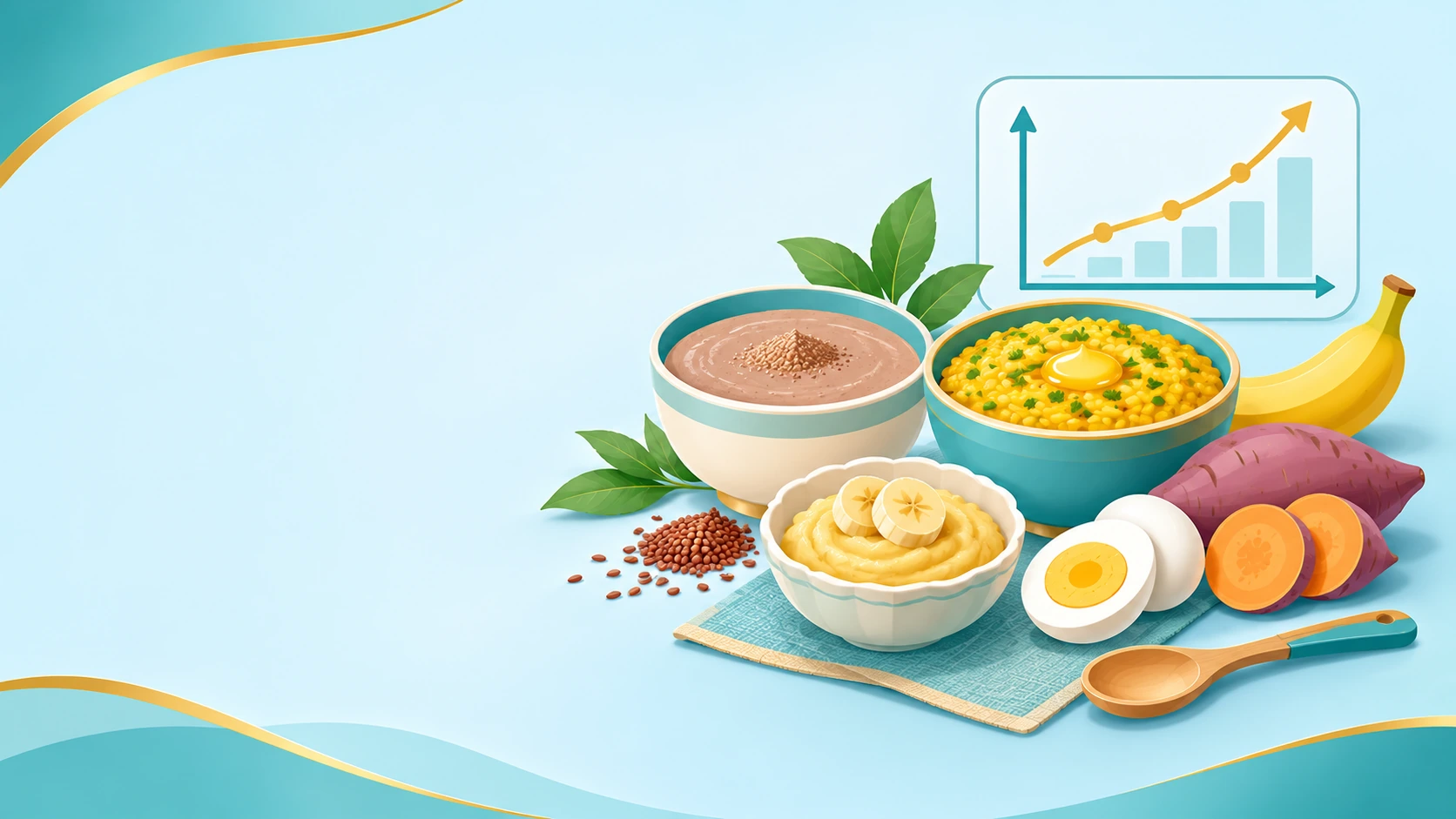
The idea is to give foods that pack more calories and protein into each spoonful. Add them gradually, one at a time, and watch for any reaction.
- Ghee or oil: a small amount (start with a few drops to half a teaspoon in a meal) adds calories. Increase slowly as your pediatrician advises.
- Ragi: a calcium-rich porridge. Cook it well and mix with milk or breast milk and a little ghee.
- Dal-rice khichdi: moong dal khichdi with vegetables and ghee. Mash well at 6 months and thicken the texture over time.
- Banana, sweet potato and potato: mashed, they give easy energy.
- Avocado: mashed, rich in healthy fats.
- Curd and paneer: full-fat, from 6 months in small amounts. Cow’s or buffalo milk as a drink should wait until 12 months.
- Egg: a well-cooked yolk or whole egg, mashed. Early introduction of egg and peanut is generally advised, unless your pediatrician says otherwise.
- Nut and seed powders: a pinch of finely powdered almonds, cashews or peanuts mixed into porridge. Never give whole nuts to a child under 4 because of choking risk.
- Fish and chicken: well-cooked, deboned and mashed or pureed.
- Lentils and legumes: thoroughly cooked and mashed.
| Time |
Food |
| On waking |
Breastfeed |
| Breakfast |
Ragi porridge with milk and 1/2 teaspoon ghee |
| Mid-morning |
Breastfeed and mashed banana |
| Lunch |
Moong dal khichdi with vegetables and 1/2 teaspoon ghee |
| Afternoon |
Breastfeed, or curd with a little mashed fruit |
| Evening |
Sweet potato mash or egg yolk |
| Dinner |
Rice with dal and mashed vegetables |
| Before bed |
Breastfeed |
This is an example, not a fixed prescription. Your pediatrician can adjust it for your baby’s age, allergies and growth.
- Honey before 12 months, because of the risk of infant botulism
- Added salt and sugar in baby food
- Cow’s milk as the main drink before 12 months
- Whole nuts, whole grapes, hard raw carrots and popcorn, which can cause choking
- Packaged baby food with added sugar, and sugary drinks
- Force-feeding or feeding in front of a screen, which makes mealtimes stressful and does not help weight gain
- Offer food when the baby is alert and hungry, not overtired
- Serve small portions often, and let the baby set the pace
- Offer the same food many times. Babies often need 8 to 10 tries before accepting a new taste
- Stay with the baby at mealtimes and make it a calm, social moment
- Keep feeding breast milk alongside solids until at least 2 years if possible
Book a visit if you notice any of these:
- Weight is flat or falling across two checks, or crossing downward across growth curves
- Refusing most feeds, gagging a lot or vomiting often
- Repeated loose stools or frequent infections
- Pale skin, extreme tiredness or poor milestone progress
- Weight below the standard curve for age
- A premature baby or low birth weight baby whose growth is not being tracked
The Pediatrics department at Genesiss Hospital, BTM Layout, tracks weight, length and head size on WHO growth charts, advises on age-appropriate feeding and checks for causes of slow growth. We are at 17, 100 Feet Ring Road, near Jayadeva Metro, BTM 2nd Stage, Bengaluru 560076. Read about child growth and development or call +91 98867 77592 to book a visit.
What is the normal weight of a 1 year old baby in India?
Many healthy 1-year-olds weigh around 8 to 10 kg, but the normal range is wide. What matters is that your baby's weight follows a steady curve on the WHO growth chart used by your pediatrician.
How can I increase my baby's weight fast?
There is no safe quick fix. Frequent feeds, energy-dense foods such as ghee added to home-cooked meals, treating infections and anemia, and regular growth checks are the safe route. Avoid syrups or powders unless prescribed.
Is ghee good for baby weight gain?
A small amount of ghee added to food adds calories and is commonly used. Start with a few drops to half a teaspoon per meal and increase gradually as your pediatrician advises. It does not replace a balanced diet.
Which foods should I avoid giving a baby who is underweight?
Avoid honey before 12 months, added salt or sugar, whole nuts and packaged baby foods with added sugar. Do not replace meals with milk-based drinks.
Does my baby need a weight gain supplement?
Not unless a doctor prescribes one after checking the cause. Supplements can mask a medical problem, and some can upset the baby's stomach.
How often should I weigh my baby?
At routine pediatric visits. Weighing at home every day causes unnecessary worry because weight naturally goes up and down. A monthly check in the first year is usually enough, or as your pediatrician advises.
My baby eats very little. Should I worry?
Appetite varies from day to day. Worry if weight is flat or falling, the baby is unusually tired, or refuses feeds repeatedly. These need a medical review.
17, 100 Feet Ring Road, near Jayadeva Metro, BHBCS Layout, BTM 2nd Stage, BTM Layout, Bengaluru, Karnataka 560076.
Phone: +91 98867 77592 | Email: contact@genesisshospital.com
Emergency and trauma care are available round the clock.
Book an appointment | Contact us | Our doctors
This article is for general health information. It is not a substitute for examination, diagnosis or treatment by a qualified doctor. If you think you may have an emergency, go to the nearest emergency department or call the hospital.