Medically reviewed by: Dr. Haridarshan G J, MBBS, MD (Pediatrics), Consultant Pediatrician Last reviewed: 16 October 2026
Many parents notice a yellow tinge on their newborn’s face or eyes on the second or third day and wonder whether something is wrong. In most babies, this is newborn jaundice, a common and usually harmless condition that fades within about two weeks. In a smaller number of babies, bilirubin rises higher and needs treatment. This guide explains the difference, what the numbers mean, and what to do at home.
Key points: Jaundice that first appears after the first 24 hours and fades by about 2 weeks is usually physiological and harmless. Jaundice in the first 24 hours, jaundice that spreads to the legs, a baby who feeds poorly or is very sleepy, or jaundice beyond 2 weeks needs a doctor’s check promptly. Sunlight is not a reliable treatment. Keep feeding often.
Jaundice is a yellow color of the skin and the whites of the eyes caused by bilirubin. Bilirubin is a yellow pigment formed when old red blood cells break down. Before birth, the mother’s body clears it. After birth, the baby’s liver must do this work, and a newborn’s liver is still maturing. Newborn red blood cells also break down faster. Together, these cause bilirubin to build up in the first few days.
About 6 in 10 full-term babies and 8 in 10 premature babies become visibly jaundiced in the first week.
This is the most common type. It appears after 24 hours, usually on day 2 or 3, peaks around day 3 to 5 (a little later in premature babies), and fades by about 2 weeks in a full-term baby. The baby feeds, passes urine and stools normally and is alert.
In the first week, if the baby is not getting enough milk, bilirubin is passed out in stools less efficiently. Frequent, well-latched feeds usually help. It is a feeding issue, not a reason to stop breastfeeding.
This appears after the first week, in a healthy baby who is feeding and gaining weight well. A substance in breast milk slows bilirubin clearance. It can last several weeks and usually resolves on its own. A doctor should still confirm that nothing else is causing it.
This is jaundice that starts in the first 24 hours, rises quickly, or lasts longer than expected. Causes include blood group mismatch between mother and baby (ABO or Rh), G6PD deficiency (an enzyme condition that is relatively common in India), bruising or a collection of blood under the scalp, infection, thyroid problems and, rarely, liver or bile duct conditions. These babies need prompt evaluation.
- Look in natural daylight or a bright white light, not a colored bulb.
- Gently press a finger on the baby’s nose or forehead. When you lift it, check whether the skin looks yellow.
- Look at the whites of the eyes and the gums.
- Check how far the yellow color has spread. Jaundice usually starts on the face and moves down to the chest, belly and then the legs. The further down it spreads, the higher the bilirubin is likely to be.
A phone camera or an app cannot measure bilirubin reliably. Only a skin bilirubin meter or a blood test can.
Parents often search for a “normal bilirubin level in newborn”. The honest answer is that it depends on the baby’s age in hours, how early or late the baby was born, and whether there are risk factors such as blood group mismatch or G6PD deficiency. Doctors plot the baby’s bilirubin on an age-in-hours chart and compare it with treatment thresholds that are lower for premature babies and babies with risk factors.
| Test |
What it does |
| Transcutaneous bilirubin (skin meter) |
Quick screening scan on the forehead or chest, no needle |
| Total serum bilirubin (blood test) |
Confirms the level and is used with the chart to decide treatment |
| Direct (conjugated) bilirubin |
Checked when jaundice lasts beyond 2 weeks or stools are pale |
| Blood group, Coombs test, G6PD, blood count |
Looks for the cause when bilirubin is high or rises quickly |
Feed 8 to 12 times in 24 hours. More feeds mean more urine and stool, and bilirubin leaves the body through both. If the baby is sleepy, wake the baby for feeds. A lactation consultant or the pediatric team can help if latching is difficult.
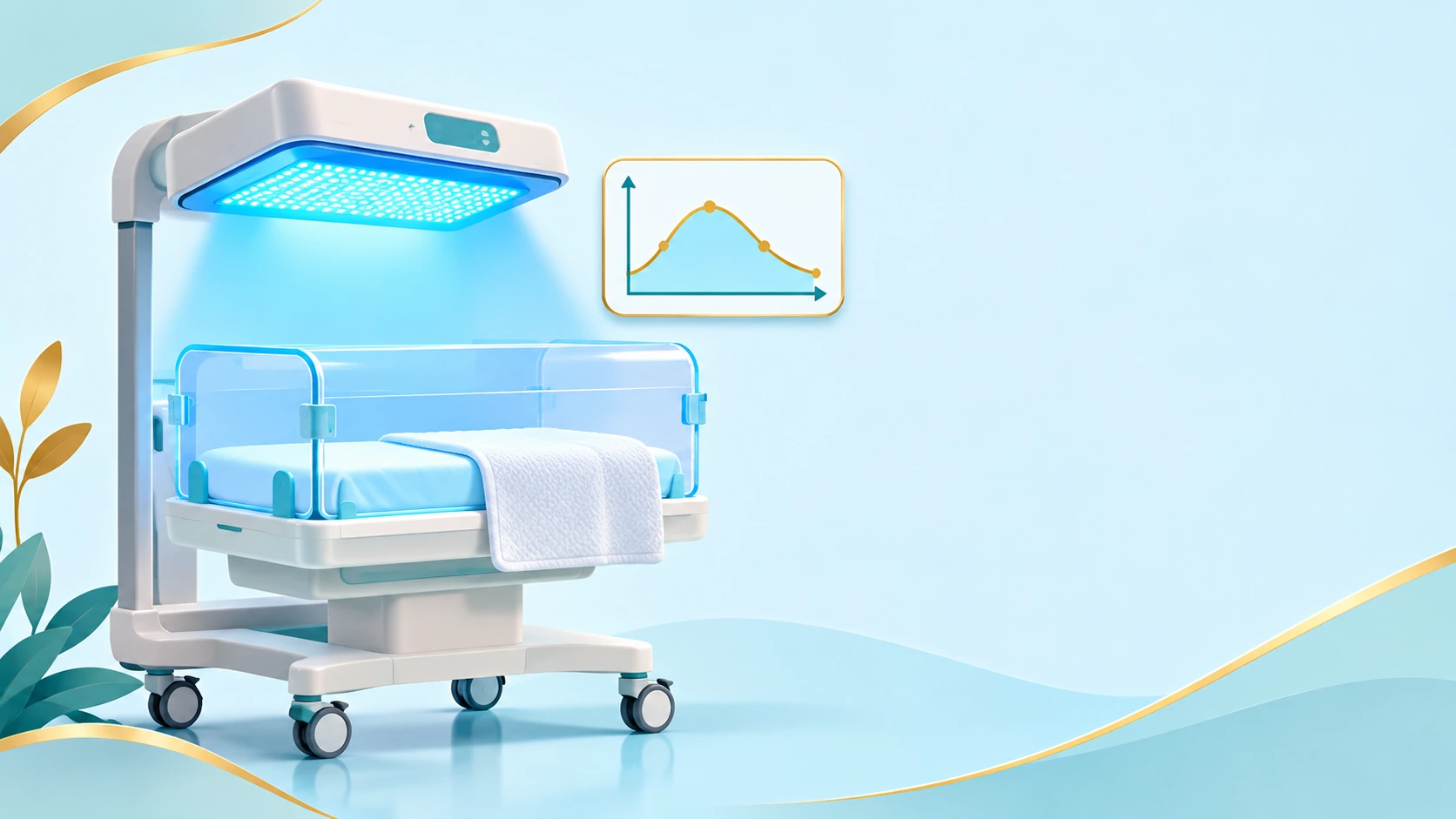
Phototherapy uses special blue light that changes bilirubin into a form the baby can pass in urine and stool. The baby lies undressed except for a diaper, with eye protection, under the light or on a light blanket. Treatment is usually continued for hours to a couple of days, with repeat bilirubin tests. Feeding continues during phototherapy. It does not hurt, although babies can be fussy and have loose stools.
Rarely, when bilirubin reaches very high levels, a doctor may replace the baby’s blood in a hospital with a neonatal intensive care unit. This is uncommon and is the reason that rapid or very high jaundice must never be ignored.
It is a very common belief, but placing a baby in sunlight is not a reliable treatment. The amount of sun needed to lower bilirubin could cause sunburn or overheating, and the right wavelengths cannot be controlled. A baby who looks jaundiced should be checked by a doctor, not left in the sun. Normal, brief, shaded daylight exposure during routine care is fine, but it does not replace a medical assessment.
- Feed frequently and make sure the latch is good
- Keep a log of feeds, wet diapers and stools for the doctor
- Attend every follow-up visit after discharge, usually within 48 to 72 hours of leaving the hospital
- Do not give water, sugar water, herbal drops, “gripe water” or any home remedy for jaundice. They fill the tummy without nutrition and can cause harm
- Do not stop breastfeeding unless a doctor specifically advises it
Contact the pediatrician or go to the hospital the same day if the baby has any of the following: yellow color in the first 24 hours of life, yellow color reaching the legs or soles, very sleepy or hard to wake, poor feeding, fewer than 6 wet diapers a day after day 5, pale or clay-colored stools, dark tea-colored urine, a high-pitched cry, arching of the back, fever, or jaundice lasting more than 2 weeks.
The Pediatrics department at Genesiss Hospital, BTM Layout, offers newborn check-ups, guidance on feeding and growth, bilirubin assessment as clinically needed, and follow-up for infants after delivery. Families from BTM Layout, Jayanagar, JP Nagar, Koramangala, HSR Layout and Bannerghatta Road can reach us at 17, 100 Feet Ring Road, near Jayadeva Metro, BTM 2nd Stage, Bengaluru 560076. Emergency and trauma care are available round the clock. Your pediatrician will tell you which services are right for your baby, based on the baby’s age and condition.
Is newborn jaundice dangerous?
Most jaundice is mild and harmless. High bilirubin that is not treated can affect the brain, which is why doctors use charts and follow-up visits to decide who needs treatment. Prompt checking is what keeps jaundice safe.
How long does jaundice last in a newborn?
Physiological jaundice usually fades by 2 weeks in full-term babies and by 3 weeks in premature babies. Breast milk jaundice can last longer. Any jaundice beyond these limits should be evaluated.
Can I treat my baby's jaundice with sunlight?
Sunlight is not a recommended or reliable treatment. It cannot be measured, and the baby can overheat or be sunburnt. A doctor will decide if phototherapy is needed.
Should I stop breastfeeding if my baby has jaundice?
Almost always, no. Frequent breastfeeding helps clear bilirubin. Stop only if your doctor advises it for a specific medical reason.
What is a normal bilirubin level in a newborn?
It depends on the baby's age in hours, gestational age and risk factors. Doctors use age-specific charts rather than one fixed number.
Does G6PD deficiency cause jaundice?
Yes. G6PD deficiency makes red blood cells break down faster, which can cause early and rapid jaundice. It is checked when jaundice is higher than expected or starts early.
Will my baby need to stay in hospital for phototherapy?
Many babies who need phototherapy are treated in hospital so that bilirubin can be monitored closely. Your pediatrician will advise on the right setting.
17, 100 Feet Ring Road, near Jayadeva Metro, BHBCS Layout, BTM 2nd Stage, BTM Layout, Bengaluru, Karnataka 560076.
Phone: +91 98867 77592 | Email: contact@genesisshospital.com
Emergency and trauma care are available round the clock.
Book an appointment | Contact us | Our doctors
This article is for general health information. It is not a substitute for examination, diagnosis or treatment by a qualified doctor. If you think you may have an emergency, go to the nearest emergency department or call the hospital.