Medically reviewed by: Dr. Raju R, MBBS, MS, MCh (Urology), FIAGES, FMAS, Consultant Urologist and Andrologist Last reviewed: 24 October 2026
Most of us never think about emptying our bladder until we cannot. Urinary retention is the inability to pass urine fully, or at all. It can come on suddenly with severe discomfort, or build up quietly over months, with a weak stream and a feeling that the bladder is never empty. It affects men more often than women, particularly after the age of 50, but it can happen at any age and for many reasons. This guide explains the two types, the causes, the tests and the treatments.
Key points: Acute urinary retention, where you suddenly cannot pass urine and have a painful, full bladder, is an emergency. Chronic retention develops slowly and can silently damage the bladder and kidneys. The most common cause in men is an enlarged prostate. Some everyday medicines, such as cold remedies and certain antihistamines, can trigger it. A simple bladder scan can show how much urine is left after passing urine.
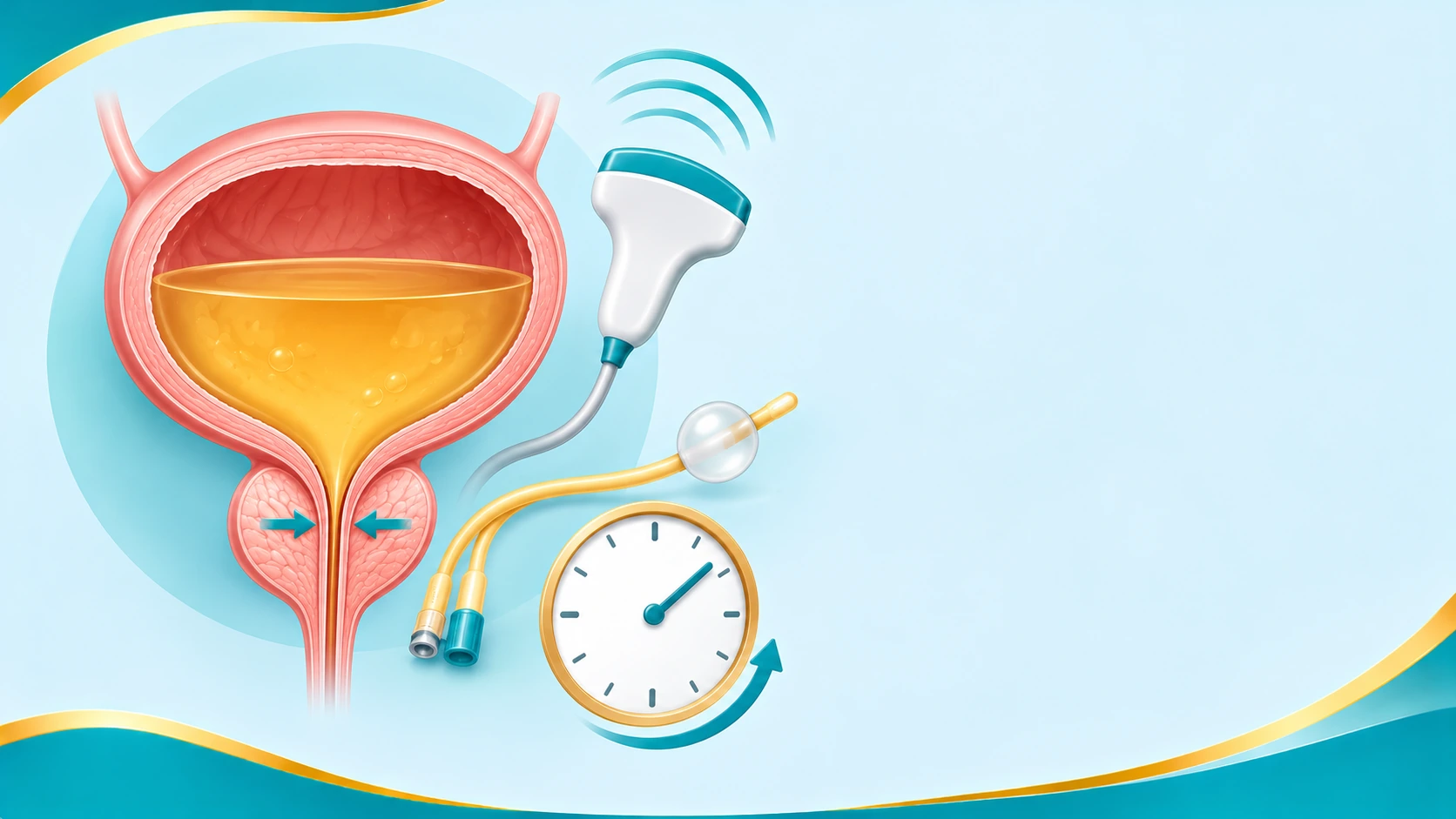
The bladder stores urine, and when you pass urine, the bladder muscle squeezes and the outlet relaxes. Retention happens when the bladder cannot empty because something blocks the outlet, or because the bladder muscle or its nerves are weak.
|
Acute retention |
Chronic retention |
| Onset |
Sudden, over hours |
Gradual, over weeks to months |
| Symptoms |
Unable to pass urine, severe lower belly pain, strong urge |
Weak stream, hesitancy, feeling of incomplete emptying, frequent small voids, dribbling, leakage |
| Pain |
Usually painful |
Often absent |
| Urgency |
Medical emergency |
Needs prompt evaluation |
| Common causes |
Enlarged prostate, medicines, constipation, surgery, infection |
Enlarged prostate, urethral stricture, weak bladder muscle, nerve problems |
Go to the emergency department immediately if you cannot pass urine for 6 to 8 hours and have lower belly pain or a swollen, tender lower abdomen. Do not wait, and do not take extra water or pills to force urine out. Also seek urgent care if retention comes with back weakness, numbness in the groin or leg, loss of bowel control or fever.
- Difficulty starting urine (hesitancy)
- A weak or interrupted stream
- Straining to pass urine
- Feeling that the bladder is not empty after passing urine
- Passing small amounts very often
- Waking at night to pass urine
- Leakage or dribbling of urine without control (overflow incontinence)
- Lower belly discomfort or fullness
- Repeated urine infections
- Enlarged prostate (BPH): the most common cause in older men
- Urethral stricture: narrowing of the urine tube after infection, injury or catheter use
- Bladder stones or bladder neck narrowing
- Tight foreskin (phimosis) in some men
- Tumours of the prostate or bladder (less often)
- Severe constipation, where a loaded bowel presses on the bladder outlet
- Pelvic organ prolapse or a large fibroid in women
- Diabetes with nerve damage
- Spinal cord or back injury, or a slipped disc pressing on nerves
- Stroke, Parkinson’s disease or multiple sclerosis
- Prolonged overstretching of the bladder
- Anticholinergic medicines, such as those for overactive bladder
- Some antihistamines and cold remedies containing decongestants
- Certain antidepressants, antipsychotics, muscle relaxants and strong painkillers (opioids)
- Spinal or general anesthesia and some surgeries, especially in the pelvis or rectum or after hernia repair
- Childbirth in some women
Infection or inflammation of the prostate or urethra, or shingles near the lower spine, can also cause retention.
Because it builds slowly and may not hurt, people adapt, passing urine more often, getting up at night and leaking a little. Over time, the bladder stretches, infections recur, stones form and pressure can back up to the kidneys and harm them. This is why a weak stream or incomplete emptying deserves attention early.
- History and examination: including a check of the abdomen, genitals, and in men, a prostate examination
- Bladder scan or ultrasound: measures post-void residual (PVR), the amount of urine left after passing urine. A significant PVR suggests retention
- Urine test: to look for infection or blood
- Blood tests: kidney function, blood sugar and, in men, PSA when appropriate
- Ultrasound of kidneys and bladder: to look for stones, prostate size or swelling of the kidneys
- Uroflowmetry: measures the strength of the urine stream
- Cystoscopy: a thin camera to look inside the urethra and bladder
- Urodynamic tests: to study the bladder muscle and nerves in selected cases
In acute retention, a thin tube (catheter) is passed to drain the urine and relieve pain. It is usually passed through the urethra, or through the lower abdomen if that is not possible. The amount drained is noted, and the catheter may be left for a few days. A trial without a catheter follows when the cause has been treated.
| Cause |
Possible treatment |
| Enlarged prostate |
Medicines to relax the prostate or shrink it, and surgery such as TURP or HoLEP if needed. See our page on enlarged prostate (BPH) treatment |
| Urethral stricture |
Dilatation, internal urethrotomy or reconstructive surgery |
| Bladder stones |
Removal with endoscopic procedures |
| Constipation |
Laxatives and a high-fiber diet |
| Medicine-related |
Your doctor may change or stop the medicine. Never stop a prescribed medicine on your own |
| Weak bladder muscle or nerve problems |
Timed and double voiding, medicines, and in some patients intermittent self-catheterization, taught by a nurse or doctor |
| Infection |
Antibiotics and drainage as needed |
Some people with a weak bladder learn to pass a clean, thin catheter several times a day to empty the bladder. This can protect the kidneys and prevent infections and leakage when done correctly. Training from a nurse or doctor is essential.
- Pass urine when you feel the urge, and do not hold it for hours
- Take your time and relax. Try double voiding, which means waiting a minute and trying again
- Treat constipation with fiber, fluids and activity
- Check the labels of cold and allergy remedies, and ask a pharmacist or doctor if you have an enlarged prostate
- Keep diabetes controlled to protect the nerves
- Do not take sleeping pills, strong painkillers or other sedatives unless prescribed
- Have regular check-ups if you have prostate problems
- A weak, slow or interrupted stream
- Straining or a feeling of incomplete emptying
- Repeated urine infections
- Dribbling or leakage
- A history of prostate problems, diabetes or back injury with new urinary symptoms
- Blood in the urine, or burning. See our guides on urinary tract infection and frequent urination causes
The Urology and Kidney Care department at Genesiss Hospital, BTM Layout, examines urinary symptoms, performs tests such as bladder scan and uroflowmetry and discusses treatment options for each patient. Emergency care is available round the clock. We are at 17, 100 Feet Ring Road, near Jayadeva Metro, BHBCS Layout, BTM 2nd Stage, Bengaluru 560076, and patients come from Jayanagar, JP Nagar, Koramangala, HSR Layout and Bannerghatta Road. See our Urology and Kidney Care department or the bladder disorders page, or call +91 98867 77592.
What is the most common cause of urinary retention?
In men, an enlarged prostate (BPH) is the most common cause. Other causes include urethral stricture, constipation, nerve problems, certain medicines and recent surgery.
Is urinary retention an emergency?
Acute retention, with sudden inability to pass urine and pain, is an emergency and needs a catheter. Chronic retention develops slowly, but should be evaluated early to protect the bladder and kidneys.
Can urinary retention go away on its own?
Sometimes, if the cause is temporary, such as a medicine or constipation, but it needs a medical check. Do not wait if you cannot pass urine at all.
Which medicines can cause urinary retention?
Decongestant cold remedies, some antihistamines, anticholinergic bladder medicines, certain antidepressants, muscle relaxants and strong painkillers. Ask your doctor before stopping any prescribed medicine.
What is post-void residual urine?
It is the urine left in the bladder after passing urine, measured by a quick bladder scan or ultrasound. A high amount suggests that the bladder is not emptying well.
Can women have urinary retention?
Yes. It can happen after childbirth or surgery, with pelvic prolapse or fibroids, certain medicines or nerve conditions, though it is less common than in men.
How is urinary retention treated?
A catheter relieves the bladder in acute retention, and treatment of the cause follows: medicines, procedures such as prostate surgery, stricture treatment or training in self-catheterization depending on the cause.
17, 100 Feet Ring Road, near Jayadeva Metro, BHBCS Layout, BTM 2nd Stage, BTM Layout, Bengaluru, Karnataka 560076.
Phone: +91 98867 77592 | Email: contact@genesisshospital.com
Emergency and trauma care are available round the clock.
Book an appointment | Contact us | Our doctors
This article is for general health information. It is not a substitute for examination, diagnosis or treatment by a qualified doctor. If you think you may have an emergency, go to the nearest emergency department or call the hospital.