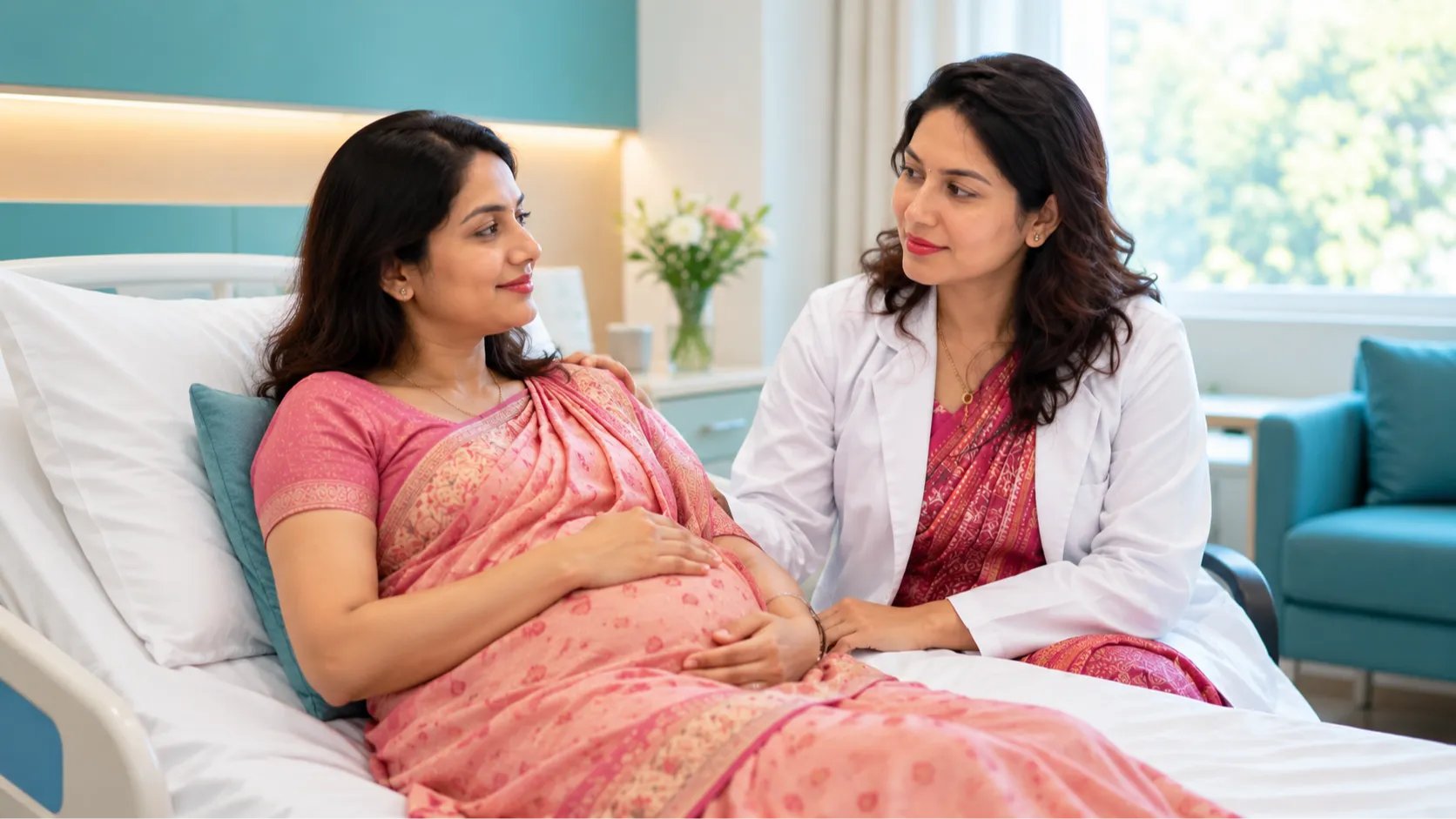
Quick answer: Painless normal delivery means a vaginal birth with epidural pain relief. A thin tube placed in your lower back delivers medicine that numbs the lower half of your body while you stay awake. You still feel pressure and can push, but the sharp pain of contractions is much reduced. It is considered safe for most healthy pregnancies when given by a trained anaesthesia team. In Bangalore, packages at private hospitals roughly range from INR 60,000 to INR 1,50,000.
The idea of childbirth without overwhelming pain sounds almost too good to be true to many expecting mothers, yet painless normal delivery in Bangalore is a widely available and well-established option at well-equipped private hospitals, including at Genesiss Hospital in BTM Layout. If the fear of labour pain has been holding you back from feeling excited about your delivery, this guide walks you through how painless delivery works, how safe it is, what it costs in a city like Bangalore and what recovery typically looks like.
Painless normal delivery does not mean you feel nothing at all, and it does not change the fact that you are still having a natural, vaginal delivery. It refers to the use of an epidural, a form of regional pain relief given through a thin tube placed in the lower back. It numbs sensation in the lower half of the body while you remain fully awake and alert throughout labour.
You can still feel pressure and the urge to push, which is important for a safe delivery. The sharp, exhausting pain of contractions is significantly reduced or removed. This is why doctors often prefer the more precise term “epidural delivery” to “no pain”, since the experience varies a little between individuals.
|
Normal delivery without an epidural |
Normal delivery with an epidural |
| Type of birth |
Vaginal |
Vaginal |
| Pain of contractions |
Felt fully |
Significantly reduced or removed |
| You are awake and alert |
Yes |
Yes |
| Pressure and urge to push |
Felt |
Usually still felt, sometimes reduced |
| Who gives it |
Not applicable |
A trained anaesthetist |
Once you are in established labour and your medical team confirms you are a suitable candidate, the steps are usually:
- Preparation. A drip is placed in a vein in your arm, and you sit or lie on your side in a curled position.
- Numbing the area. An anaesthetist cleans your lower back and numbs a small patch of skin.
- Placing the tube. A thin catheter is placed in the epidural space of your lower spine.
- Delivering the medicine. Pain-relieving medication flows through the catheter in carefully controlled amounts.
- Adjusting as needed. The dose can be topped up or reduced throughout labour depending on how you feel and how labour is progressing.
According to the NHS guidance on pain relief in labour, setting up an epidural takes about 10 minutes, and it may take another 10 to 15 minutes to start working. Your obstetrician and the anaesthesia team monitor you and your baby closely throughout. Every pregnancy is different, so your doctor assesses your suitability based on your health history, how labour is progressing and your baby’s condition at the time. For more on the technique, see our page on regional and local anaesthesia.
Epidural pain relief during labour is one of the most extensively studied and widely practised forms of pain management in modern obstetrics. It is considered safe for the vast majority of healthy pregnancies when given by a trained anaesthesia team in a hospital setting.
Like any medical procedure, it is not entirely without minor, temporary side effects for some women, and it is not automatically suitable for every pregnancy. That is why the decision is made jointly between you, your obstetrician and the anaesthetist, and not as a fixed default.
| Side effect |
What to know |
| Heavy or numb legs |
Depends on the medicine used, and wears off after delivery |
| A drop in blood pressure |
Uncommon, and the drip helps keep it stable |
| Mild backache at the injection site |
Usually mild and temporary |
| Difficulty passing urine |
A small tube may be used for a short time if needed |
| Headache after the epidural |
Not common, and it can be treated |
| Longer pushing stage |
Can happen, so the team may wait longer before you push |
Some health conditions can make an epidural unsuitable, such as certain bleeding or clotting problems, an infection near the injection site or some spine conditions. If you have specific health conditions or concerns, raise them early in your pregnancy so your care team can plan well before your due date.
This is one of the most common fears we hear, and it deserves a clear answer. For most healthy pregnancies, a well-timed epidural does not meaningfully increase the likelihood of needing a caesarean. It may, in some cases, modestly lengthen certain stages of labour, particularly the pushing stage, which your medical team accounts for as they monitor your progress. The NHS notes that a longer pushing stage can mean an assisted delivery with forceps or vacuum is needed in some cases, and that waiting for the baby’s head to descend before pushing reduces that chance.
The choice between a normal delivery and a caesarean depends on a range of clinical factors specific to you and your baby, and your doctor assesses this in real time and not based on the fact that you have chosen an epidural. To understand how doctors decide between the two approaches, read our guide on normal delivery vs C-section and our article on C-section recovery: timeline, diet and care.
Painless delivery cost is one of the first questions most expecting parents ask. Hospital charges vary depending on the type of room you choose, the length of your stay, whether any additional monitoring or intervention is needed and the specific hospital you deliver at.
As a general guide, painless normal delivery packages at established private hospitals in Bangalore typically range between roughly INR 60,000 and INR 1,50,000 or more, though this is only a broad indication and not a quote.
| What affects the package |
Why it matters |
| Room category |
Shared, semi-private or private rooms are priced differently |
| Length of stay |
An uncomplicated vaginal birth usually means a short stay |
| Epidural and anaesthesia team charges |
Often a modest addition to the delivery package |
| Extra monitoring or procedures |
Needed in some labours, and they change the bill |
| Tests, scans and baby care |
May be itemised separately |
| Insurance and maternity cover |
Waiting periods and limits depend on your policy |
Your exact package, including the epidural charge, room category and any additional tests, will be confirmed during your antenatal consultations, so you have complete clarity well before your due date and no surprises afterwards.
One of the most reassuring aspects of choosing painless normal delivery is that recovery generally mirrors recovery from any vaginal delivery. An epidural does not typically extend hospital stay or slow down healing. Most mothers are up and moving within hours of delivery, and hospital stays for an uncomplicated vaginal birth are usually short, often just a couple of days. Any lingering backache from the epidural site is usually mild and temporary.
Your doctor will guide you on postnatal care, breastfeeding support and what to watch for during recovery, tailored to your specific delivery.
| Myth |
Fact |
| “An epidural harms the baby.” |
It is considered safe for the baby in the vast majority of healthy pregnancies, and your team monitors you both throughout |
| “You cannot push with an epidural.” |
You are awake and can usually still push, and your team guides you |
| “It causes long-term back pain.” |
Back soreness, if any, is usually mild and short lived |
| “It means you will end up with a C-section.” |
For most healthy pregnancies it does not meaningfully raise that chance |
| “Only for very painful labours.” |
It can be discussed with your doctor as a choice from early in pregnancy |
If painless normal delivery is something you are considering, the best time to bring it up is during your antenatal visits, well before labour begins, so your obstetrician and the hospital’s anaesthesia team can plan ahead and answer your specific questions.
At Genesiss Hospital in BTM Layout, Dr. Divya J G, an Obstetrician and Gynaecologist with over 14 years of experience, regularly guides expecting mothers through exactly this decision, helping you understand your options without pressure either way.
What is painless normal delivery?
Painless normal delivery is a vaginal birth with epidural pain relief. A thin tube in the lower back delivers medicine that numbs the lower body while you stay awake. You still feel pressure and can push, but the sharp pain of contractions is greatly reduced. The experience varies a little between women.
Is an epidural safe for the baby?
Yes, when administered appropriately by a trained anaesthesia team, epidural pain relief is considered safe for the baby in the vast majority of healthy pregnancies. Your doctor monitors both you and your baby closely throughout labour to confirm everything is progressing normally.
Can every pregnant woman opt for a painless delivery?
Most healthy pregnancies are suitable candidates, but not every case is the same. Your obstetrician and anaesthetist assess your health history and how your labour is progressing before confirming that an epidural is the right choice. Certain bleeding, clotting, infection or spine conditions may make it unsuitable.
How much does painless normal delivery cost in Bangalore?
Packages at established private hospitals in Bangalore typically range from roughly INR 60,000 to INR 1,50,000 or more, depending on room category, length of stay and any extra monitoring. This is a broad indication and not a quote. Your exact package is confirmed during antenatal consultations.
Does a painless delivery cost much more than a regular delivery?
It usually adds a modest amount to your overall delivery package, mainly to cover the anaesthesia team and monitoring involved. Ask for a detailed cost breakdown during your antenatal consultation so you know exactly what is included well in advance.
Does an epidural increase the chance of a C-section?
For most healthy pregnancies, a well-timed epidural does not meaningfully increase the likelihood of a caesarean. It may modestly lengthen the pushing stage, and in some cases an assisted delivery with forceps or vacuum is needed. Your doctor decides the mode of delivery based on clinical factors at the time.
How long is recovery after a painless normal delivery?
Recovery generally mirrors any vaginal delivery. Most mothers are up and moving within hours, and hospital stays for an uncomplicated vaginal birth are usually short, often a couple of days. Mild backache at the epidural site is usually temporary. Your doctor will give personalised postnatal guidance.
When should I discuss painless delivery with my doctor?
The best time is during your antenatal visits, well before labour begins. This gives your obstetrician and the anaesthesia team time to review your health, answer your questions and plan your birth. You can book an antenatal consultation at Genesiss Hospital.
If labour pain is the one thing standing between you and feeling excited about your delivery, let us talk about your options. Book a consultation with Dr. Divya J G at Genesiss Hospital, BTM Layout, to discuss painless normal delivery and build a birth plan that feels right for you.
Cost ranges are indicative and not a quote. This article is for general information and does not replace a medical consultation.