
Speciality Departments
Happy Patients
Expert Doctors
Emergency Care
Advanced Urology & Kidney Care
At Genesiss Hospital, we specialize in minimally invasive urological procedures. Our kidney care department is equipped with the latest diagnostic and surgical tools to ensure the best patient outcomes.
- ✓ Kidney Stone Laser Treatment (No Incisions)
- ✓ Prostate Care & Advanced Surgery
- ✓ Comprehensive Dialysis Services
"Our mission is to provide trusted, compassionate care using the latest medical breakthroughs."
Schedule Your Appointment
By submitting, you agree to our privacy policy.
Our Specialist
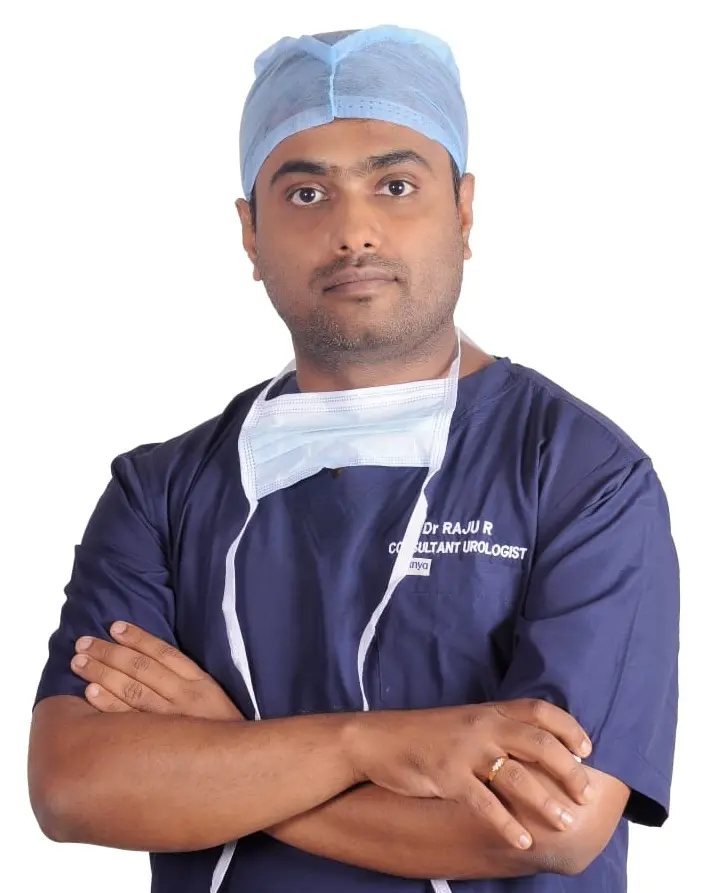
Dr. Raju
MBBS, MS, MCh (Urology) | Chief Consultant
Dr. Raju R is a highly experienced senior urologist in Bangalore with over 14+ years of expertise in advanced urology and andrology care. He has successfully performed 5000+ surgeries, specializing in kidney stone treatment, prostate care, and minimally invasive urological procedures. Known for his precision, patient-centric approach, and use of cutting-edge technology, Dr. Raju delivers safe, effective, and internationally aligned treatment outcomes.
Areas of Expertise
- Kidney Stone Treatment (ESWL, RIRS, PCNL)
- Laser Urology Procedures
- Prostate Treatment (BPH, TURP, Laser Surgery)
- Male Infertility & Andrology
- Urinary Tract Disorders
- Laparoscopic Urology Surgeries
Why Choose Dr. Raju R?
- 14+ Years of Experience in Urology.
- 5000+ Successful Surgeries.
- Expertise in Laser & Minimally Invasive Treatments.
- High Success Rate in Kidney Stone Removal
- Trusted Urologist in Bangalore
Advanced Technology & Treatment
Dr. Raju R is known for adopting the latest minimally invasive and laser technologies to ensure faster recovery and minimal pain. His expertise includes:
- • ESWL (Shock Wave Therapy): Non-surgical stone removal
- • RIRS (Laser Surgery): No-cut kidney stone treatment
- • PCNL: Advanced solution for large stones
- • Laser Prostate Surgery: Safe and effective treatment for enlarged prostate
His approach focuses on accurate diagnosis, personalized treatment planning, and faster patient recovery, making him one of the most trusted urologists in Bangalore.
Consult the Best Urologist in Bangalore
If you are experiencing kidney stones, urinary issues, or prostate problems, consult Dr. Raju R for advanced and effective treatment. Early diagnosis and the right care can prevent complications and ensure a quick recovery.Neither a normal delivery nor a C-section is automatically better for every mother or baby. When pregnancy and labour are progressing safely, a vaginal delivery is usually possible and often means a quicker physical recovery. When there is a concern about the baby’s position, placenta, labour progress, or the mother’s health, a C-section may be the safest way to deliver.
The right decision is personal. It should be based on the pregnancy in front of you, not on fear, family pressure, or another person’s birth story.
The most important thing to understand before choosing
Many mothers come to a consultation already worried that one type of birth will be more painful, more difficult, or less safe for their baby. Those concerns are understandable, but childbirth is not a competition between two delivery methods.
A vaginal delivery is a birth through the vagina after labour starts naturally or is induced when needed. A C-section is a surgical birth in which the baby is delivered through an incision in the abdomen and uterus.
Both can be safe. Both need recovery. Both can be the right choice when they match the mother’s and baby’s needs.
A healthy birth is not defined by how the baby is delivered. It is defined by making the safest decision at the right time.
When a vaginal delivery may be the right plan
For a low-risk pregnancy, a vaginal delivery is often planned because it avoids abdominal surgery and usually allows the mother to move around sooner after birth.
Labour begins when the uterus contracts and the cervix starts opening. As labour progresses, the baby moves down through the birth canal. Some women deliver without pain relief, while others may choose or need pain-management options. Sometimes, if the baby needs help to be born sooner, an assisted vaginal delivery may be considered.
A vaginal delivery can still be demanding. Labour may be long, contractions can be intense, and some mothers may have stitches after a tear. But many women recover well, especially when there are no complications.
When a C-section may be safer
A C-section is not a shortcut or a failure of labour. It is an important procedure that can protect a mother and baby when vaginal birth is not the safest option.
A doctor may advise a C-section when:
- The placenta is covering the cervix.
- The baby is lying sideways or in another position that makes vaginal birth unsafe.
- The baby shows signs of distress during labour.
- Labour is not progressing despite appropriate support.
- The umbilical cord comes down before the baby.
- There is a serious concern with the mother’s health.
- A previous uterine surgery needs special planning.
- Pregnancy complications make a vaginal delivery unsafe.
Some C-sections are planned before labour begins. Others become necessary during labour because the situation changes. The priority is always to respond safely, not to hold on to a birth plan when the clinical picture has changed.
Which is safer for the baby?
The safest delivery method for the baby is the one that is safest for the pregnancy.
When the mother and baby are both well and there are no complications, a vaginal delivery is often suitable. When the baby is not tolerating labour, when the placenta is blocking the birth passage, or when there is a high-risk complication, a C-section may be the safer route.
A baby born by C-section is not less healthy or less strong because of the delivery method. A baby born vaginally is not automatically safer in every pregnancy. What matters is whether the delivery was planned and managed according to the baby’s condition at that time.
Is a C-section easier than a normal delivery?
The answer depends on which part of birth you are talking about.
With a C-section, you do not experience labour in the same way because the procedure is carried out under anaesthesia. But recovery can take more time because the body is healing from surgery.
With a vaginal delivery, labour itself may be physically and emotionally intense. However, when there are no major complications, mothers may be able to get up, walk, and return to normal movement earlier.
Neither route is easy. They are simply different experiences with different recovery needs.
What recovery usually feels like after a vaginal delivery
After a vaginal delivery, many mothers feel tired and sore, especially if labour was long or stitches were needed. The first few days may involve bleeding, cramps, discomfort while sitting, and difficulty finding a comfortable feeding position.
Recovery can be easier when you have rest, support at home, good hydration, and time to adjust to caring for a newborn.
You should speak to your doctor if you have severe pain, very heavy bleeding, fever, foul-smelling discharge, increasing swelling, or difficulty passing urine.
What recovery usually feels like after a C-section
A C-section is major abdominal surgery. The early days are usually focused on pain relief, walking carefully, feeding the baby comfortably, and looking after the incision.
The wound should be kept clean and dry according to your doctor’s instructions. It is normal to need help getting up, sitting down, and carrying out routine tasks initially. But worsening pain, redness, swelling, discharge from the wound, fever, breathlessness, or heavy bleeding need medical attention.
Online recovery rules such as the 5-5-5 rule or 7-7-7 rule can be reminders to slow down after birth, but they are not medical treatment plans. Every mother’s recovery needs are different. The advice should be based on the delivery, blood loss, wound healing, pain level, breastfeeding concerns, and overall health.
What about delivery at 37 weeks?
A baby may need to be delivered at 37 weeks when there is a medical reason to do so. This can include concerns such as high blood pressure, reduced fluid around the baby, fetal growth concerns, placenta-related problems, or other pregnancy complications.
If there is no reason to deliver early, the timing of delivery should be decided after assessing the mother and baby. A planned C-section is not scheduled early simply for convenience. Your obstetrician will explain why a particular timing is being recommended for your pregnancy.
Can you have a vaginal delivery after a previous C-section?
Some women may be suitable for a vaginal birth after a previous C-section. This is often called VBAC, or vaginal birth after Caesarean.
The decision depends on several details:
- Why the earlier C-section was needed.
- The type of scar on the uterus.
- The number of previous uterine surgeries.
- The current baby’s position and growth.
- Placenta location.
- The mother’s overall health.
- The hospital’s ability to respond quickly if an emergency arises.
A previous C-section does not mean every future baby must be born by C-section. It means the next pregnancy needs an individual discussion and a carefully planned delivery approach.
Do C-section babies look different at birth?
Sometimes, yes, but only temporarily.
Babies born vaginally may have a slightly moulded head shape immediately after birth because of the pressure of moving through the birth canal. Babies born by C-section may look less moulded at first. These are normal early observations and usually settle naturally.
A baby’s appearance at birth does not decide their health or development.
How Dr Divya J G helps you prepare for birth
Pregnancy becomes less frightening when you understand what your doctor is watching for and why your delivery plan may need to change.
During antenatal visits, Dr Divya J G can help you understand your scan findings, baby’s position, placenta location, medical history, and the signs that may influence the delivery plan. She is an Obstetrician and Gynaecologist, IVF Specialist, and Laparoscopic Surgeon at Genesiss Hospital.
For many mothers, the most useful part of antenatal care is having time to ask the questions that are difficult to ask during labour. At Genesiss Hospital’s maternity service, pregnancy monitoring is planned around both the mother’s health and the baby’s well-being, from routine check-ups to high-risk pregnancy support when needed.
When should you contact your doctor urgently?
Get prompt medical advice during pregnancy or after delivery if you notice:
- Heavy bleeding.
- Severe lower abdominal pain.
- Severe headache, blurred vision, chest pain, or breathlessness.
- Reduced fetal movements.
- Fluid leaking before labour begins.
- Fever or chills.
- Increasing pain or discharge from a C-section wound.
- Feeling faint, unusually weak, or unwell.
- Persistent anxiety, sadness, panic, or thoughts of harming yourself or the baby.
For concerns outside a routine pregnancy visit, the Obstetrics and Gynaecology team can assess what needs attention and what can safely be monitored.
Frequently Asked Questions
Which is better for a baby, normal delivery or C-section?
Neither is better in every situation. A vaginal delivery is often suitable in an uncomplicated pregnancy. A C-section may be safer when there is fetal distress, placenta previa, an unsafe baby position, or another medical concern.
What is the safest method of delivery?
The safest method depends on the mother’s health, the baby’s condition, the placenta, the baby’s position, and how labour progresses. Your obstetrician recommends the method that is safest for your individual pregnancy.
Is a C-section more painful than a normal delivery?
Labour pain is usually more intense during a vaginal delivery. Pain after birth may be greater after a C-section because it involves surgery. Pain relief and recovery vary from one mother to another.
What are the disadvantages of a C-section?
A C-section may involve a longer recovery, incision care, surgical pain, and considerations for future pregnancies. It can still be the safest and most appropriate choice when medically needed.
Is delivery at 37 weeks safe?
Delivery at 37 weeks may be advised when there is a medical reason. If the mother and baby are well, your obstetrician will guide the safest timing based on the pregnancy rather than a fixed rule.
Does the 5-5-5 rule apply after a C-section?
The 5-5-5 rule is an informal recovery reminder, not a medical guideline. Your activity, rest, wound care, and movement after a C-section should follow the advice of your treating doctor.
Can I have a normal delivery after a previous C-section?
Some women can have a vaginal birth after a previous C-section. It depends on the earlier surgery, current pregnancy, baby’s position, and other clinical factors. Your doctor can assess whether it is a safe option for you.
The best delivery plan is one that keeps room for safety, not one that creates pressure to deliver in a particular way. If you would like to discuss your pregnancy and delivery options, you can request a consultation with Dr Divya J G.
Your Path to Recovery
Consultation
Detailed discussion with our expert specialists.
Diagnosis
State-of-the-art testing for precise results.
Treatment
Advanced surgery or medical management.
Recovery
Personalized follow-up and rehab care.
Patient Success Stories
See what our patients have to say about their journey with us
Frequently Asked Questions
How do I book an appointment?

Do you accept medical insurance?
What are the visiting hours for inpatients?
Need medical care?
Book your appointment with our expert doctors in just a few clicks.

Why Choose Genesiss Hospital?
World-class healthcare tailored to your needs.
Expert Care
Led by the renowned Dr. Raju and his specialist team.
Advanced Tech
Latest diagnostic tools and surgical equipment.
5000+ Happy Patients
Providing compassionate care for over a decade.
24/7 Support
Emergency response and trauma care available round-the-clock.
Book an Appointment
Fill in the details below and we'll confirm your slot shortly.