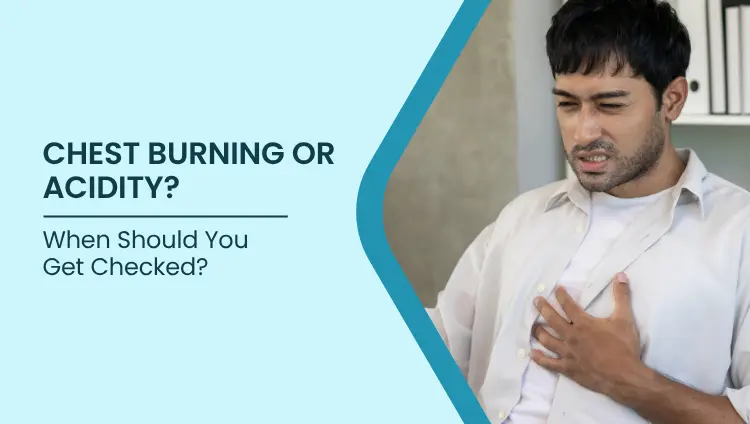
Chest burning after a heavy meal or while lying down is often linked to acid reflux, commonly called acidity or heartburn. It may occur with a sour taste, belching or food coming back into the throat. However, chest discomfort should not automatically be treated as acidity. Seek urgent hospital care when the burning feels like pressure or tightness, occurs during physical activity, spreads to the arm, jaw or back, or comes with sweating, breathlessness, faintness or nausea. Consult a doctor when symptoms keep returning, disturb sleep, cause swallowing difficulty or do not improve with basic lifestyle changes.
Heartburn is a burning sensation felt behind the breastbone. It may rise from the lower chest towards the throat.
It commonly happens:
- After a large or heavy meal
- After eating late at night
- When bending forward
- When lying down soon after eating
- After consuming a food or drink that triggers symptoms
- During pregnancy
- When reflux has been recurring for some time
Other symptoms may include:
- A sour or bitter taste
- Fluid or food coming back into the mouth
- Frequent belching
- Upper abdominal discomfort
- Throat irritation
- Hoarseness
- A persistent dry cough
- A feeling of a lump in the throat
- Discomfort while swallowing
Acid reflux occurs when stomach contents move back into the oesophagus, the tube that carries food from the mouth to the stomach. The oesophagus does not have the same protective lining as the stomach, so repeated exposure can cause burning and irritation.
Not always.
Acid reflux can happen occasionally, particularly after overeating or lying down shortly after a meal. Gastroesophageal reflux disease, or GERD, refers to reflux that occurs repeatedly, causes troublesome symptoms or leads to complications.
You may need to be assessed for GERD when chest burning:
- Occurs several times a week
- Regularly disturbs sleep
- Requires frequent use of antacids
- Keeps returning after medicine is stopped
- Causes chronic cough or throat symptoms
- Is accompanied by regurgitation
- Interferes with eating or daily activities
- Has continued for several weeks
A doctor may be able to diagnose reflux from the symptom pattern and medical history. Tests are not automatically required for every person. Further evaluation may be advised when symptoms are unusual, persistent or not improving with appropriate treatment.
Acid reflux and heart-related chest discomfort can sometimes feel similar. It may not be possible to tell the difference safely at home.
The following patterns can provide clues, but they are not a substitute for medical assessment.
| Feature |
More commonly reported with acid reflux |
More concerning for a heart-related problem |
| Timing |
After meals or when lying down |
During activity, exertion or emotional stress |
| Sensation |
Burning behind the breastbone |
Pressure, heaviness, squeezing or tightness |
| Taste |
Sour or bitter taste may occur |
Usually not present |
| Regurgitation |
May occur |
Not typical |
| Position |
May worsen on bending or lying down |
May occur in any position |
| Spread of discomfort |
May rise towards the throat |
May spread to the arm, shoulder, jaw, neck or back |
| Other symptoms |
Belching or throat irritation |
Sweating, breathlessness, faintness, unusual weakness or nausea |
These patterns can overlap. A heart attack can sometimes feel like indigestion or burning rather than dramatic pain. Women, older adults and people with diabetes may also have less typical symptoms.
The American Heart Association advises seeking urgent help when chest discomfort lasts, returns or occurs with breathlessness, sweating, nausea, light-headedness or discomfort elsewhere in the upper body.
Do not assume that new, severe or unexplained chest burning is acidity. Seek urgent hospital care if it feels like pressure or tightness, begins during physical effort, spreads to the arm, jaw or back, or occurs with sweating, breathlessness, faintness or marked weakness.
Brief home monitoring may be reasonable when:
- The burning is mild
- It appeared after a clearly heavy meal
- You have experienced similar doctor-diagnosed reflux before
- There is no breathlessness, sweating or faintness
- There is no pressure or squeezing sensation
- The discomfort does not spread elsewhere
- You can swallow normally
- Symptoms are already improving
- You have no concerning medical history
Monitoring should not become a habit of repeatedly self-treating unexplained chest discomfort.
A symptom that keeps returning deserves evaluation, even when each episode eventually settles.
Consult a general physician or gastroenterologist when:
- Chest burning occurs repeatedly
- Symptoms happen more than once or twice a week
- You rely on antacids regularly
- Symptoms wake you at night
- You have a persistent sour taste
- Food or fluid frequently returns to the throat
- You have an ongoing cough or hoarse voice
- Symptoms are not improving after sensible dietary and routine changes
- You are unsure whether the discomfort is digestive or heart-related
- The symptoms began after starting a new medicine
- You have been self-medicating for several weeks
NIDDK advises seeing a doctor when suspected GERD does not improve with non-prescription treatment or lifestyle changes. Medical attention is also recommended for chest pain, swallowing problems, persistent vomiting, bleeding or unexplained weight loss.
Do not delay a consultation when chest burning occurs with:
- Difficulty swallowing
- Pain while swallowing
- Food feeling stuck
- Repeated vomiting
- Vomiting blood
- Vomit that looks like coffee grounds
- Black or tar-like stools
- Blood in the stool
- Unexplained weight loss
- Loss of appetite
- Persistent upper abdominal pain
- Recurrent choking
- New symptoms after the age of 50
- Worsening symptoms despite treatment
- Anaemia found on a blood test
These features do not confirm a serious condition, but they may require tests to look for inflammation, narrowing, ulcers, bleeding or another digestive disorder.
A general physician is a sensible first doctor when the cause is unclear or you have not been examined before.
The physician can:
- Review your symptoms and medical history
- Check blood pressure and other vital signs
- Assess heart-related risk
- Examine the chest and abdomen
- Review current medicines
- Decide whether urgent tests are needed
- Refer you to a gastroenterologist or another specialist
A gastroenterologist may be appropriate when the symptoms clearly suggest recurring reflux or another digestive condition.
Consider a gastroenterology consultation when there is:
- Frequent heartburn
- Regurgitation
- Difficulty swallowing
- Persistent upper abdominal discomfort
- Recurrent vomiting
- Long-standing symptoms
- Symptoms that have not responded to initial treatment
- A possible need for endoscopy or reflux testing
Go directly to a hospital for urgent assessment when the symptoms could be heart-related or are severe and unexplained.
When you are upright, gravity helps keep stomach contents lower. Lying down soon after eating makes it easier for reflux to reach the oesophagus.
Night-time symptoms may be more likely when you:
- Eat a large dinner
- Eat shortly before sleeping
- Lie flat immediately after eating
- Consume a personal trigger food in the evening
- Drink alcohol close to bedtime
- Have excess abdominal pressure
- Are pregnant
- Have a hiatal hernia
Try to leave approximately two to three hours between the evening meal and lying down. NIDDK includes avoiding meals shortly before lying down among the lifestyle measures that may reduce GERD symptoms.
Persistent night-time reflux still needs evaluation. Repeatedly adjusting sleep or relying on an antacid without understanding the cause may delay appropriate care.
There is no universal list that affects everyone in exactly the same way.
Commonly reported triggers include:
- Large or high-fat meals
- Fried foods
- Very spicy foods
- Chocolate
- Coffee
- Alcohol
- Carbonated drinks
- Tomato-based foods
- Citrus fruits
- Peppermint
- Late-night meals
You do not need to remove every food on this list unless it affects you.
A food and symptom diary can be more useful than following an extremely restrictive diet. Record what you ate, the portion size, the timing and whether you lay down afterwards.
Sometimes the amount and timing of food matter more than one particular ingredient.
Stress does not create stomach acid from nothing, but it can affect how digestive symptoms are experienced and managed.
During stressful periods, people may:
- Eat quickly
- Skip meals and then overeat
- Drink more coffee
- Sleep poorly
- Smoke more
- Consume alcohol
- Become more sensitive to discomfort
- Forget prescribed medicines
Stress may therefore worsen symptoms without being the only cause.
Chest discomfort should not be labelled as anxiety or stress until important physical causes have been considered.
Some medicines can contribute to reflux or irritate the digestive tract.
Examples may include:
- Certain pain medicines
- Some blood-pressure medicines
- Selected asthma medicines
- Sedatives
- Some antidepressants
- Iron or potassium supplements in some patients
Do not stop a prescribed medicine on your own. Ask the prescribing doctor whether the timing, dose or choice of medicine could be affecting your symptoms.
Bring a complete list of medicines, vitamins, supplements and non-prescription products to the appointment.
NIDDK notes that several medicines can cause reflux or make existing symptoms worse.
Antacids may provide short-term relief by neutralising stomach acid. Frequent use, however, can hide a problem that needs diagnosis.
Regular self-treatment can create several difficulties:
- Symptoms may keep returning without the cause being addressed
- The medicine may interact with another treatment
- Some products may not be suitable for kidney disease
- Excessive use can cause bowel or electrolyte problems
- Serious symptoms may be incorrectly labelled as acidity
Other acid-reducing medicines are also available, but the correct dose and duration depend on the diagnosis and the individual patient.
Consult a doctor when you need medicine frequently or symptoms return as soon as it is stopped.
No.
Doctors often begin by reviewing the symptoms, medical history, eating pattern and response to appropriate treatment.
An upper GI endoscopy may be considered when:
- Swallowing is difficult or painful
- Food becomes stuck
- Bleeding is suspected
- There is persistent vomiting
- Weight loss is unexplained
- Anaemia is present
- Symptoms are not responding to treatment
- Another digestive condition needs to be excluded
- The doctor is concerned about a complication
During endoscopy, a flexible tube with a camera is used to examine the oesophagus, stomach and first part of the small intestine. A small tissue sample may be taken when needed.
Other tests, including oesophageal pH monitoring, may be used in selected cases when the diagnosis remains uncertain or treatment is not working as expected.
For mild symptoms without warning signs:
- Eat smaller portions
- Avoid lying down immediately after meals
- Eat dinner earlier
- Identify your personal trigger foods
- Limit alcohol
- Stop smoking
- Avoid very tight clothing around the abdomen
- Maintain a comfortable body weight where relevant
- Record when the burning happens
- Note whether it is related to meals, activity or sleep
- Avoid taking several acidity medicines together without advice
Do not continue these measures for weeks while ignoring persistent symptoms. They are supportive steps, not a substitute for evaluation when symptoms keep returning.
Be ready to describe:
- Where the burning starts
- Whether it rises towards the throat
- Whether it happens after meals
- Whether activity brings it on
- Whether lying down makes it worse
- Whether there is a sour taste
- Whether food comes back into the mouth
- Whether swallowing is difficult
- Whether you have cough or hoarseness
- Which medicines you take
- How often you use antacids
- Whether there is weight loss, vomiting or bleeding
- Whether you have diabetes, high blood pressure or heart disease
These questions help the doctor decide whether the symptom is likely to be reflux or needs another type of assessment.
Arrange a medical consultation when chest burning:
- Keeps returning
- Happens several times a week
- Disturbs sleep
- Requires frequent antacids
- Continues despite lifestyle changes
- Occurs with regurgitation
- Causes chronic cough or hoarseness
- Began after a medicine change
- Makes you avoid normal meals
- Is difficult to distinguish from chest pain
Seek prompt care for swallowing difficulty, persistent vomiting, bleeding, black stools, loss of appetite or unexplained weight loss.
Seek urgent hospital care for new or severe chest pressure, pain during activity, breathlessness, sweating, faintness or discomfort spreading to the arm, jaw, shoulder or back.
Genesiss Hospital is a NABH-accredited multi-speciality hospital in BTM Layout, Bengaluru, near Jayadeva Metro. Its gastroenterology service includes care for acid reflux, GERD, digestive symptoms, liver and gallbladder conditions, and endoscopy-based evaluation.
Patients with repeated acidity, regurgitation, swallowing concerns or symptoms that have not improved can read about acid reflux and GERD evaluation at Genesiss Hospital. A consultation can help clarify whether lifestyle measures, medicines, tests or specialist follow-up may be appropriate.
Occasional heartburn can happen after a heavy or late meal. Repeated chest burning, however, deserves more attention than continued self-medication.
Notice when the symptom occurs, what makes it worse and whether it comes with regurgitation, swallowing problems or warning signs. Most importantly, do not try to distinguish serious chest pain from acidity entirely on your own.
Patients with persistent or unclear symptoms can request an appointment at Genesiss Hospital. Mention whether the burning is related to meals, activity, sleep or swallowing when requesting the consultation.
How do I know if chest burning is acidity?
Acidity-related burning often appears behind the breastbone after meals or when lying down. It may occur with sour taste, belching or regurgitation. However, symptoms can overlap with heart-related chest discomfort. New, severe or unexplained burning should be assessed rather than diagnosed at home.
When should I worry about a burning sensation in my chest?
Seek urgent care when the burning feels like pressure or tightness, occurs during activity, spreads to the arm, jaw or back, or comes with sweating, breathlessness, nausea, faintness or severe weakness. Arrange a consultation when burning keeps returning, disturbs sleep or does not improve.
Which doctor should I see for chest burning and acidity?
A general physician is a suitable first doctor when the cause is unclear. A gastroenterologist may be appropriate for repeated heartburn, regurgitation, swallowing difficulty or symptoms that have not improved with initial treatment. Severe or possibly heart-related symptoms require urgent hospital assessment.
Why does my chest burn after eating?
Chest burning after eating may occur when stomach contents move back into the oesophagus. Large portions, high-fat meals and lying down soon after eating can contribute. Repeated symptoms may indicate GERD or another digestive condition and should be discussed with a doctor.
Can gas cause a burning sensation in the chest?
Indigestion, reflux and trapped gas can cause upper abdominal or chest discomfort. The sensation alone cannot safely identify the cause. Chest pressure, breathlessness, sweating, spreading pain or symptoms during physical effort should not be assumed to be gas.
Does frequent acidity require an endoscopy?
Not everyone with acidity needs an endoscopy. Doctors often begin with the symptom history and appropriate treatment. Endoscopy may be advised when there is swallowing difficulty, bleeding, persistent vomiting, unexplained weight loss, anaemia or symptoms that do not respond to treatment.
Is it safe to take an antacid whenever acidity occurs?
Occasional use may help some people, but frequent self-treatment is not a long-term solution. Antacids can interact with medicines and may not be suitable for everyone. Consult a doctor when you need them repeatedly, symptoms return quickly or the cause of the chest discomfort is uncertain.