Speciality Departments
Happy Patients
Expert Doctors
Emergency Care
Our Specialized Treatments
Comprehensive urological solutions provided by experts using the latest medical technology for better patient outcomes.

Bladder Cancer
Comprehensive care for bladder cancer, from early detection to advanced treatment.
Learn More
Kidney Cancer
Comprehensive care for kidney cancer, offering advanced diagnostic and treatment options.
Learn MoreBook Your Appointment
Fill out the form and our representative will call you back within 15 minutes.
Our Specialist
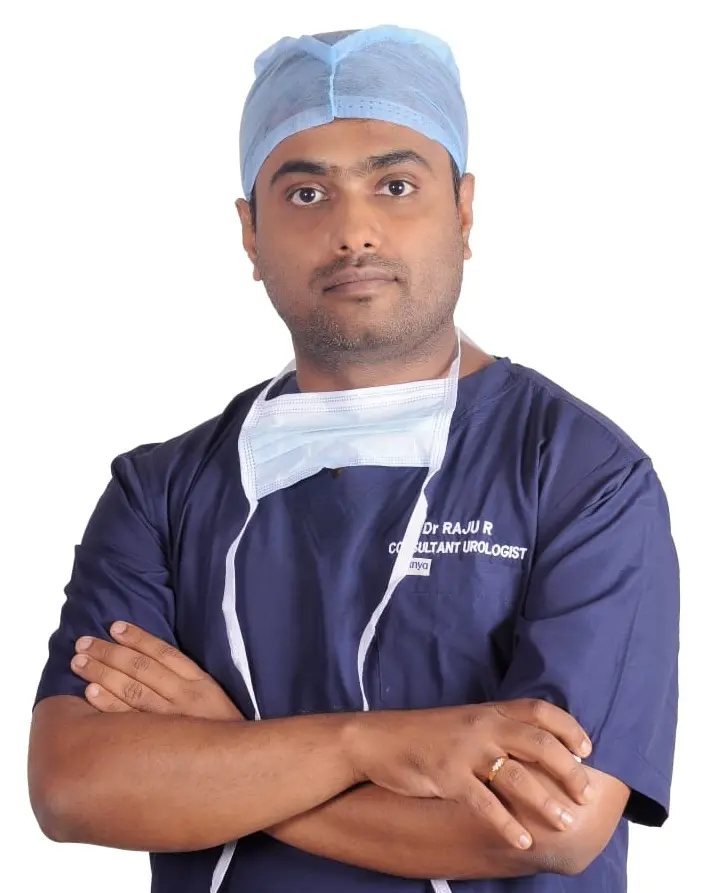
Dr. Raju
MBBS, MS, MCh (Urology) | Chief Consultant
Dr. Raju R is a highly experienced senior urologist in Bangalore with over 14+ years of expertise in advanced urology and andrology care. He has successfully performed 5000+ surgeries, specializing in kidney stone treatment, prostate care, and minimally invasive urological procedures. Known for his precision, patient-centric approach, and use of cutting-edge technology, Dr. Raju delivers safe, effective, and internationally aligned treatment outcomes.
Areas of Expertise
- Kidney Stone Treatment (ESWL, RIRS, PCNL)
- Laser Urology Procedures
- Prostate Treatment (BPH, TURP, Laser Surgery)
- Male Infertility & Andrology
- Urinary Tract Disorders
- Laparoscopic Urology Surgeries
Why Choose Dr. Raju R?
- 14+ Years of Experience in Urology.
- 5000+ Successful Surgeries.
- Expertise in Laser & Minimally Invasive Treatments.
- High Success Rate in Kidney Stone Removal
- Trusted Urologist in Bangalore
Advanced Technology & Treatment
Dr. Raju R is known for adopting the latest minimally invasive and laser technologies to ensure faster recovery and minimal pain. His expertise includes:
- • ESWL (Shock Wave Therapy): Non-surgical stone removal
- • RIRS (Laser Surgery): No-cut kidney stone treatment
- • PCNL: Advanced solution for large stones
- • Laser Prostate Surgery: Safe and effective treatment for enlarged prostate
His approach focuses on accurate diagnosis, personalized treatment planning, and faster patient recovery, making him one of the most trusted urologists in Bangalore.
Consult the Best Urologist in Bangalore
If you are experiencing kidney stones, urinary issues, or prostate problems, consult Dr. Raju R for advanced and effective treatment. Early diagnosis and the right care can prevent complications and ensure a quick recovery.Your Path to Recovery
Consultation
Detailed discussion with our expert specialists.
Diagnosis
State-of-the-art testing for precise results.
Treatment
Advanced surgery or medical management.
Recovery
Personalized follow-up and rehab care.
Patient Success Stories
See what our patients have to say about their journey with us
Frequently Asked Questions
How do I book an appointment?

Do you accept medical insurance?
What are the visiting hours for inpatients?
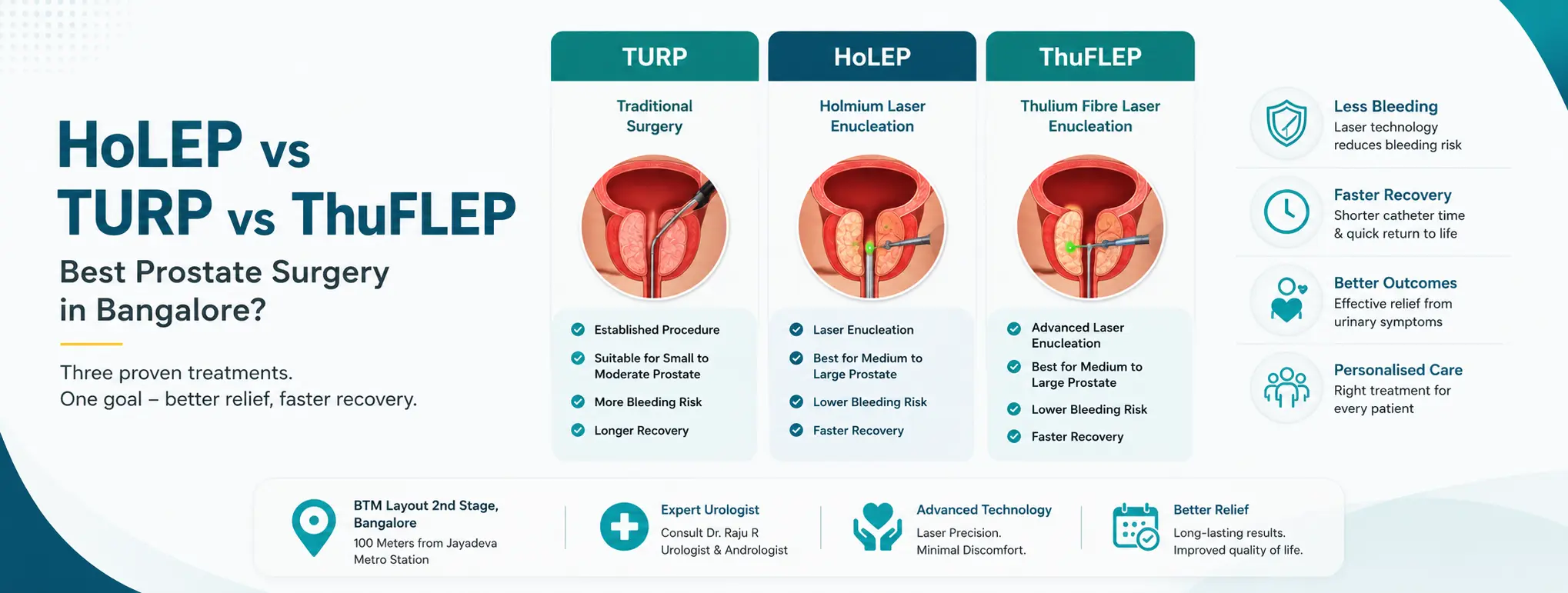
If you are comparing HoLEP, TURP, and ThuFLEP for enlarged prostate treatment, the right surgery depends on prostate size, urinary symptoms, bleeding risk, age, medical condition, and surgeon assessment. TURP is a traditional prostate surgery, while HoLEP and ThuFLEP are laser-based enucleation techniques that may offer faster recovery and better suitability for larger prostates in selected patients.
At Genesiss Multispeciality Hospital, BTM Layout, prostate treatment is evaluated by Dr Raju R, Consultant Urologist and Andrologist. The goal is to choose the safest and most effective treatment based on the patient’s prostate condition, not simply the newest procedure.
Genesiss Hospital is located at 17, 100 Feet Ring Road, BTM Layout 2nd Stage, approximately 100 metres from Jayadeva Metro Station. The hospital is accessible for patients from BTM Layout, JP Nagar, Jayanagar, Bannerghatta Road, Silk Board, Tavarekere, and South Bangalore.
Quick Comparison: HoLEP vs TURP vs ThuFLEP
| Factor | TURP | HoLEP | ThuFLEP |
|---|---|---|---|
| Full form | Transurethral Resection of Prostate | Holmium Laser Enucleation of Prostate | Thulium Fibre Laser Enucleation of Prostate |
| Technology | Electrical resection | Holmium laser | Thulium fibre laser |
| Best suited for | Small to moderate prostate enlargement | Moderate to large prostate enlargement | Moderate to large prostate enlargement |
| Bleeding risk | Higher than laser options | Usually lower | Usually lower |
| Catheter duration | Usually longer | Often shorter | Often shorter |
| Hospital stay | Usually longer than laser options | Often shorter | Often shorter |
| Tissue removal | Resection in chips | Enucleation of obstructing prostate tissue | Laser enucleation of obstructing tissue |
| Recovery | Good, but may take longer | Often faster | Often faster |
| Key advantage | Established standard procedure | Strong option for large prostates | Advanced laser precision in selected cases |
This table is only a general comparison. The right prostate surgery should be selected after urology evaluation, prostate size assessment, urine flow testing, scan findings, and medical review.
What Is TURP?
TURP stands for Transurethral Resection of the Prostate.
It is one of the oldest and most established surgeries for enlarged prostate. During TURP, the urologist removes obstructing prostate tissue through the urinary passage using a resectoscope.
TURP may be considered for:
- Enlarged prostate causing urinary blockage
- Weak urine stream
- Frequent urination
- Night-time urination
- Incomplete bladder emptying
- Urinary retention
- Symptoms not improving with medicines
TURP is effective, but recovery may involve temporary catheter use, mild bleeding, burning urination, and urinary urgency during healing.
What Is HoLEP?
HoLEP stands for Holmium Laser Enucleation of the Prostate.
In HoLEP, a holmium laser is used to separate and remove the enlarged part of the prostate that is blocking urine flow. It is done through the urinary passage, without an external cut.
HoLEP may be considered for:
- Moderate to large prostate enlargement
- Patients needing better tissue clearance
- Patients where lower bleeding risk is important
- Men with urinary retention due to enlarged prostate
- Cases where long-term durability is important
HoLEP is often preferred for larger prostates because it can remove more obstructing tissue while reducing bleeding risk in suitable patients.
What Is ThuFLEP?
ThuFLEP stands for Thulium Fibre Laser Enucleation of the Prostate.
It is another laser-based prostate surgery where a thulium fibre laser is used to remove obstructing prostate tissue. ThuFLEP is similar in principle to HoLEP because both are enucleation procedures.
ThuFLEP may be considered for:
- Enlarged prostate causing bladder outlet obstruction
- Patients suitable for laser prostate surgery
- Moderate to large prostate size
- Cases where precision and controlled cutting are useful
- Patients where faster recovery is expected after evaluation
Availability and suitability depend on hospital setup, surgeon expertise, and patient condition.
Which Is Safer: TURP or HoLEP?
Both TURP and HoLEP are established prostate surgeries when performed by trained urologists.
However, HoLEP may offer advantages in selected patients, including:
- Lower bleeding risk
- Shorter catheter duration
- Shorter hospital stay
- Suitability for larger prostates
- Better long-term tissue clearance in some cases
TURP remains useful for many men, especially when prostate size and patient condition are suitable.
The safer option depends on the individual patient.
Is HoLEP Better Than TURP?
HoLEP may be better than TURP for selected patients, especially when:
- Prostate size is large
- Bleeding risk needs to be reduced
- Faster catheter removal is preferred
- Patient wants quicker return to normal activities
- Long-term relief from obstruction is important
TURP may still be suitable when:
- Prostate enlargement is moderate
- Laser surgery is not required
- The patient is clinically suitable for traditional resection
- Surgeon recommends it based on anatomy and findings
The decision should not be made only by comparing names. It should be based on diagnosis.
Is ThuFLEP Better Than HoLEP?
HoLEP and ThuFLEP are both laser enucleation procedures.
The difference lies mainly in the laser technology used.
HoLEP uses holmium laser.
ThuFLEP uses thulium fibre laser.
Both aim to remove the obstructing prostate tissue more completely than traditional shaving-style techniques. In experienced hands, both can be effective. The choice may depend on:
- Surgeon experience
- Prostate size
- Tissue characteristics
- Bleeding risk
- Hospital technology
- Patient’s medical condition
There is no single “best” laser for every patient.
TURP vs HoLEP vs ThuFLEP: Which Surgery Gives the Best Recovery?
Recovery is usually influenced by the procedure type, prostate size, patient age, diabetes, blood thinner use, infection risk, and overall health.
In general:
- TURP recovery is reliable but may involve longer catheter duration
- HoLEP recovery is often faster in suitable patients
- ThuFLEP recovery may also be faster due to laser precision
Most patients can gradually return to routine activities within a few weeks, but complete urinary healing may take longer.
Which Prostate Surgery Is Best for Large Prostate?
For large prostate enlargement, laser enucleation procedures such as HoLEP or ThuFLEP are often considered because they can remove a larger amount of obstructing tissue.
TURP may be more suitable for small to moderate prostate enlargement.
For very large prostates, the urologist may recommend laser enucleation or another surgical approach depending on scan findings and patient condition.
What Is the Most Successful Prostate Surgery?
The most successful prostate surgery is the one that matches the patient’s condition correctly.
Success depends on:
- Correct diagnosis
- Prostate size
- Bladder function
- Surgeon experience
- Proper technique selection
- Follow-up care
- Patient health condition
A procedure may be excellent for one patient and unsuitable for another.
That is why urologist-led evaluation is essential.
Who Needs Prostate Surgery?
Prostate surgery may be advised when medicines are not enough or complications develop.
Common reasons include:
- Weak urine flow
- Frequent urination
- Waking up repeatedly at night to urinate
- Urinary retention
- Recurrent urinary infections
- Bladder stones
- Blood in urine due to prostate enlargement
- Kidney swelling due to urine blockage
- Incomplete bladder emptying
Patients with severe symptoms should not delay evaluation.
What Tests Are Needed Before Choosing Prostate Surgery?
Before deciding between TURP, HoLEP, or ThuFLEP, a urologist may advise:
- Urine test
- Blood test
- Kidney function test
- PSA test if required
- Ultrasound scan
- Prostate size measurement
- Uroflowmetry
- Post-void residual urine test
- Medical fitness evaluation
These tests help determine whether surgery is needed and which procedure is safer.
What Happens After Prostate Surgery?
After prostate surgery, patients may experience temporary symptoms such as:
- Mild blood in urine
- Burning while urinating
- Frequent urination
- Urinary urgency
- Temporary leakage
- Catheter discomfort
These symptoms usually improve as healing progresses.
Patients should contact their doctor if they develop:
- Heavy bleeding
- Fever
- Inability to pass urine
- Severe pain
- Large clots
- Worsening urinary symptoms
Can Prostate Grow Again After Surgery?
Some prostate tissue may remain after surgery because the entire prostate gland is not always removed in BPH surgery.
However, procedures like HoLEP and ThuFLEP aim to remove the obstructing inner part of the prostate more completely.
The chance of needing repeat treatment depends on:
- Procedure type
- Amount of tissue removed
- Prostate biology
- Patient age
- Long-term follow-up
This should be discussed with the urologist before surgery.
What Are the Risks of Prostate Surgery?
All surgeries have risks.
Possible risks may include:
- Bleeding
- Infection
- Burning urination
- Temporary urinary leakage
- Retrograde ejaculation
- Urethral narrowing
- Need for repeat treatment in some cases
- Anaesthesia-related risks
A proper pre-surgery assessment helps reduce risk and prepare the patient safely.
Why Choose Genesiss Hospital for Prostate Surgery in Bangalore?
Genesiss Hospital provides urology evaluation and prostate treatment planning in BTM Layout, Bangalore.
Patients may consider Genesiss Hospital because of:
- Urology care led by Dr Raju R
- Evaluation for enlarged prostate, urinary obstruction, urinary retention, and male urinary symptoms
- Treatment planning for TURP, HoLEP, laser prostate surgery, and related urology care where suitable
- Multispeciality hospital support
- Location around 100 metres from Jayadeva Metro Station
- Access for patients from BTM Layout, JP Nagar, Jayanagar, Bannerghatta Road, Silk Board, and South Bangalore
Patients can explore the Urology & Kidney Care Department for related urology services.
Meet Dr Raju R
Dr Raju R is a Consultant Urologist and Andrologist at Genesiss Multispeciality Hospital.
Patients may consult Dr Raju R for:
- Enlarged prostate symptoms
- Frequent urination
- Weak urine stream
- Night-time urination
- Urinary retention
- Blood in urine
- Prostate surgery evaluation
- Male urinary and reproductive health concerns
A proper consultation helps patients understand whether medicines, TURP, HoLEP, ThuFLEP, or another treatment option is suitable.
Local Access for Prostate Treatment in BTM Layout
Genesiss Hospital is located at 17, 100 Feet Ring Road, BTM Layout 2nd Stage.
Approximate access points:
| Location | Approximate Distance |
|---|---|
| Jayadeva Metro Station | 100 metres |
| Jayadeva Hospital Junction | 350 to 500 metres |
| BTM 1st Stage | 1.5 to 2 km |
| Bannerghatta Road Junction | 1.5 km |
| Silk Board Junction | 2 km |
| JP Nagar 2nd Phase | 3 km |
| Jayanagar 9th Block | 3 km |
| Jayanagar 4th Block | 3.5 km |
This location helps patients from South Bangalore access urology consultation, evaluation, and follow-up more conveniently.
Useful Internal Links
- Urology & Kidney Care Department
- Dr Raju R – Consultant Urologist and Andrologist
- Best Urology Hospital in BTM Layout
- Doctors at Genesiss Hospital
- About Genesiss Hospital
- Medical Specialities
When to Consult a Urologist
Consult a urologist if you have:
- Weak urine stream
- Frequent urination
- Urgency to pass urine
- Waking up many times at night
- Difficulty starting urination
- Incomplete bladder emptying
- Blood in urine
- Recurrent urinary infections
- Inability to pass urine
Early evaluation helps prevent bladder strain, kidney pressure, infections, and emergency urinary retention.
FAQs
Which is safer, TURP or HoLEP?
Both are safe when performed by experienced urologists. HoLEP may have lower bleeding risk and shorter catheter duration in suitable patients, while TURP remains effective for selected prostate sizes.
Why is HoLEP better than TURP?
HoLEP may be better for larger prostates, patients with higher bleeding risk, and those needing more complete tissue removal. However, TURP may still be suitable for moderate prostate enlargement.
What is the difference between HoLEP and ThuFLEP?
HoLEP uses holmium laser, while ThuFLEP uses thulium fibre laser. Both are laser enucleation procedures used to remove obstructing prostate tissue.
What is the most successful prostate surgery?
The most successful prostate surgery depends on the patient’s prostate size, symptoms, bladder function, age, and medical condition. No single surgery is best for everyone.
What is the safest procedure to reduce prostate size?
The safest procedure depends on patient evaluation. HoLEP, ThuFLEP, and TURP can all be safe when chosen correctly and performed by an experienced urologist.
How long is recovery from HoLEP vs TURP?
HoLEP often has shorter catheterisation and hospital stay in suitable patients. TURP recovery is also reliable but may take slightly longer depending on prostate size and patient condition.
Can prostate regrow after HoLEP?
HoLEP removes the obstructing prostate tissue, but some prostate tissue remains. The chance of needing repeat treatment is generally lower when obstruction is cleared well.
How many days rest is needed after prostate surgery?
Many patients need a few weeks of recovery before returning to normal activity. Heavy lifting, cycling, and strenuous exercise should be avoided until the urologist confirms healing.
Conclusion
HoLEP, TURP, and ThuFLEP are all important treatment options for enlarged prostate. TURP is a trusted traditional surgery, while HoLEP and ThuFLEP are laser-based techniques that may offer faster recovery and better suitability for larger prostates in selected patients.
The best prostate surgery is not decided by technology alone. It depends on prostate size, symptoms, urine flow, bleeding risk, medical condition, and surgeon expertise. At Genesiss Hospital, Dr Raju R and the urology team evaluate each patient carefully before recommending the most suitable treatment.
Need medical care?
Book your appointment with our expert doctors in just a few clicks.

Why Choose Genesiss Hospital?
World-class healthcare tailored to your needs.
Expert Care
Led by the renowned Dr. Raju and his specialist team.
Advanced Tech
Latest diagnostic tools and surgical equipment.
5000+ Happy Patients
Providing compassionate care for over a decade.
24/7 Support
Emergency response and trauma care available round-the-clock.
Book an Appointment
Fill in the details below and we'll confirm your slot shortly.