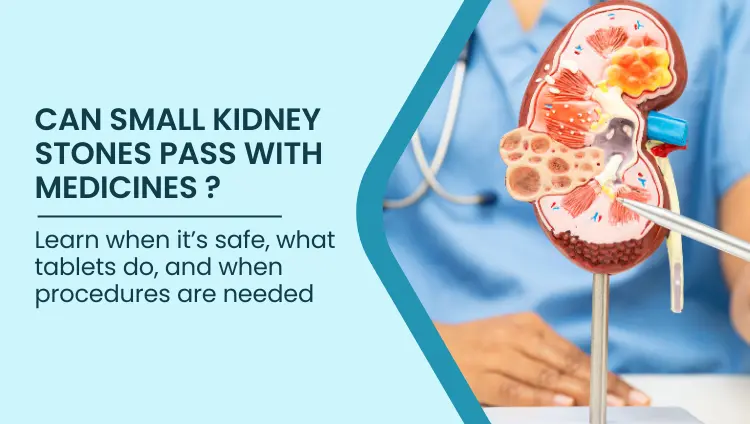
When people are diagnosed with kidney stones, the first question they ask is whether surgery is necessary. Many patients in Bangalore actively search for tablet-based treatment options hoping small stones can pass naturally without procedures. In reality, some small kidney stones can pass with medicines alone, but this is not true for everyone.
This blog explains when medicines are enough, which medicines are commonly used, how doctors decide, and when waiting can become unsafe—in a clear, patient-focused, and medically accurate way.
Yes, some can.
Small kidney stones-especially those measuring less than 5–6 mm may pass naturally through urine with the help of medicines, hydration, and monitoring. However, stone passage depends on multiple factors, not just size.
Doctors consider several factors before advising conservative (non-surgical) treatment:
- Size of the stone
- Location of the stone
- Degree of pain
- Urine flow
- Presence of infection or fever
- Kidney function
- Previous stone history
Medicines are advised only when passing the stone is considered safe.
Medicines used for conservative stone management do not dissolve stones, but they support stone passage and symptom control.
Pain control is essential during stone passage.
Doctors may prescribe:
- Diclofenac
- Aceclofenac
- Ibuprofen
- Paracetamol (for mild pain)
These medicines:
- Reduce inflammation
- Control pain during stone movement
They do not help the stone move, but make symptoms manageable.
These medicines help relax the urinary tract.
Commonly used medicines include:
- Tamsulosin
- Silodosin
- Alfuzosin
They work by:
- Relaxing ureter muscles
- Reducing spasm
- Improving urine flow
- Increasing the chance of stone passage
These medicines are effective only for selected patients.
Doctors may also prescribe:
- Medicines to control nausea or vomiting
- Urine alkalizers in selected cases
- Hydration advice tailored to the patient
These help the body tolerate stone passage better.
It is important to understand limitations.
Medicines cannot:
- Dissolve most kidney stones
- Break stones into smaller pieces
- Remove large or stuck stones
- Treat blockage with kidney swelling
- Treat infection without antibiotics
If a stone does not move, medicines alone are unsafe.
There is no fixed timeline.
- Some stones pass within a few days
- Others take weeks
- Some stop moving altogether
Regular follow-up is critical to ensure the stone is progressing and not causing silent damage.
Doctors feel comfortable continuing medicines when:
- Pain is mild or controlled
- No fever or infection is present
- Urine flow is normal
- Imaging shows stone movement
- Kidney function is stable
In such cases, observation is safe under supervision.
Conservative treatment should not be continued blindly.
Evaluation is needed if:
- Pain becomes severe or recurrent
- Fever or chills develop
- Vomiting prevents oral medicines
- Blood in urine increases
- Urine output reduces
- Pain persists beyond 1–2 weeks without movement
These signs suggest complications.
Even small stones may fail to pass due to:
- Narrow ureter anatomy
- Stone shape or surface
- Stone stuck at a bend
- Underlying urinary tract issues
- Infection or swelling around the stone
In such cases, intervention may be safer.
Doctors rely on tests to guide decisions.
These may include:
- Urine tests
- Blood tests
- Ultrasound
- CT scan (if clarity is needed)
Tests help confirm whether conservative treatment is still safe.
Most patients with small stones are treated in OPD.
Doctors decide based on:
- Pain control
- Stone movement
- Absence of infection
- Kidney function
- Overall health
Admission is required only when complications arise.
Mistakes that delay recovery include:
- Skipping follow-up scans
- Continuing medicines despite worsening pain
- Ignoring fever or vomiting
- Assuming pain relief means stone passage
- Drinking excessive water during severe pain
These mistakes increase complication risk.
Hospital-supervised conservative care helps:
- Avoid kidney damage
- Detect silent obstruction early
- Decide the right timing for procedures
- Prevent unnecessary surgery
- Ensure patient safety
Many patients avoid surgery when managed correctly.
Yes.
Conservative treatment requires:
- Repeat imaging
- Symptom review
- Easy access during pain episodes
For people around BTM Layout, Jayadeva, Jayanagar, and Bannerghatta Road, nearby hospital care improves safety and continuity.
At Genesiss Hospital:
- Small stones are evaluated carefully before observation
- Medicines are prescribed only when safe
- Progress is monitored with imaging
- Intervention is advised only when necessary
The focus is on avoiding unnecessary surgery without risking complications.
Some small kidney stones can pass with medicines alone—but not all. Conservative treatment works only when stone size, location, and patient condition allow safe passage. Medicines support the process but do not replace evaluation or follow-up.
Early medical guidance helps patients choose the safest path and avoid complications.
Can small kidney stones pass without surgery?
Yes. Small stones may pass naturally with medicines, hydration, and monitoring when conditions are safe.
Do medicines dissolve kidney stones?
No. Most kidney stones do not dissolve with medicines. Medicines help manage symptoms and support passage.
How long should I wait for a stone to pass?
Waiting time depends on stone size and movement. Regular follow-up is needed to decide safely.
When should I stop waiting and see a doctor?
If pain worsens, fever develops, vomiting occurs, or urine flow reduces, medical evaluation is required.
Which hospital should I visit near BTM Layout for kidney stones?
A nearby multispeciality hospital in BTM Layout with urology services and diagnostic facilities is suitable for safe evaluation and follow-up.